Biology questions and answers

Biology Questions and Answers

How well do you understand living things and their vital processes? Whether you are preparing for JAMB, WAEC, NECO and Post-UTME, these Biology past questions and answers cover such subjects as the chemistry of life, botany, evolution, genetics, ecology etc to help you know what to expect, improve your speed and confidence and be really prepared for the actual aptitude test.
951.

Physiological adaptation to very dry conditions in animals demonstrates

A.

Xeromorphism

B.

Hibernation

C.

Aestivation

D.

Rejuvenation

Correct answer is C

Aestivation or æstivation is a state of animal dormancy, similar to hibernation, although taking place in the summer rather than the winter. Aestivation is characterized by inactivity and a lowered metabolic rate that is entered in response to high temperatures and arid conditions.

952.

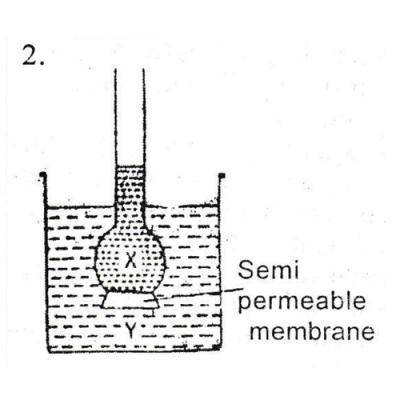
What would happen if solution Y is more concentrated than solution X in fig 2 

A.

The level of X would rise, Y would fall

B.

The level of X would rise, Y would rise

C.

The level of X and Y stands the same

D.

The level of Y would rise, X would fall

Correct answer is D

Osmosis is the spontaneous net movement of solvent molecules through a selectively permeable membrane into a region of higher solute concentration, in the direction that tends to equalize the solute concentrations on the two sides. Therefore, the level of Y (region of higher concentration) would rise, X (region of lower concentration) would fall to equalize the solute concentrations on both sides.

953.

The four classes of cnidarians include the following except

A.

Turbellaria

B.

Anthozoa

C.

Scyphozoa

D.

cubozoa

Correct answer is A

Modern cnidarians are generally classified into four main classes: sessile Anthozoa (sea anemones, corals, sea pens); swimming Scyphozoa (jellyfish) and Cubozoa (box jellies); and Hydrozoa

Turbellaria are one of the traditional sub-divisions of the phylum Platyhelminthes (flatworms).

954.

How many days is used for incubation to release a chick?

A.

21

B.

22

C.

20

D.

23

Correct answer is A

On the 21st day of incubation the chick finishes its escape from the shell. The initial break in the shell is made by the egg tooth. This is referred to as external pipping.

955.

What is the function of the contractile vacuole in paramecium?

A.

Produces enzymes

B.

Gets rid of excreta

C.

Stores and digests food

D.

Gets rid of excess water

Correct answer is D

Osmoregulation: Paramecium and amoeba live in fresh water. Their cytoplasm contains a greater concentration of solutes than their surroundings and so they absorb water by osmosis. The excess water is collected into a contractile vacuole which swells and finally expels water through an opening in the cell membrane.

Excretion of water in Paramecium is carried out by the Contractile vacuoles.