Use the diagram below to answer this question.
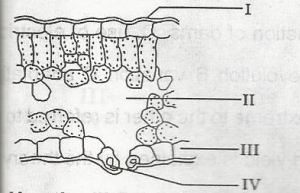
The structure that controls loss of water vapour during transpiration is labelled
l
ll
lll
lV
Correct answer is D
The stomata regulates gas exchange between the plant and environment and controls water loss by changing the size of the stomatal pore.
Guard cells are cells surrounding each stoma. They help to regulate the rate of transpiration by opening and closing the stomata.
Use the diagram below to answer this question.
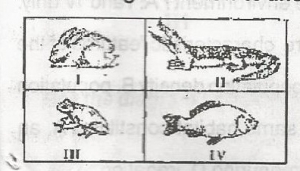
l, IV, II, and lll
IV, lll, ll, and l
l, ll, IV, and lll
lll, ll, IV, and l
Correct answer is B
- Like frogs, most toads lay their fertilized eggs in water, where they hatch into tadpoles before developing into adult toads. These amphibians need a safe, undisturbed body of water to lay their eggs in. However, a few species breed on land.
- the mother alligator typically lays about 35 eggs in a nest made of mud, sticks, and other plant matter.
- Rabbits sometimes dig a burrow in which to give birth
Use the diagram below to answer this question.
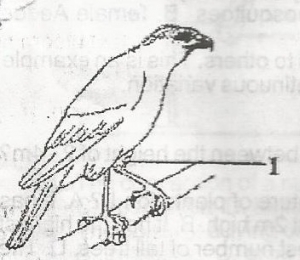
flesh
fruits
seeds
nectar
Correct answer is A
No explanation has been provided for this answer.
Use the diagram below to answer this question.
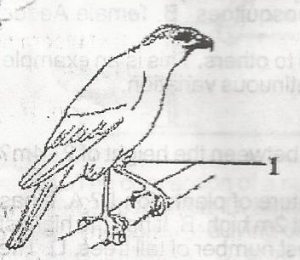
The main function of the feathers covering the part labeled I is to?
prevent ectoparasites from attacking the animal
generate heat to keep the animal warm
provide some power for flight
serve as insulator to maintain body heat
Correct answer is D
No explanation has been provided for this answer.
Use the diagram below to answer this question.
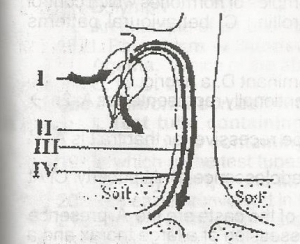
During photosynthesis, the arrow labeled ll represents the
escape of mineral salts
absorption of energy from the sun
release of carbon (IV) oxide
release of oxygen as a by-product
Correct answer is D
No explanation has been provided for this answer.
JAMB Subjects
Aptitude Tests