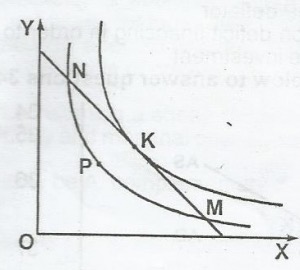
To move from point M to K, the consumer has to increase the
Consumption of X and reduce the consumption of Y
Expenditure on Y
Expenditure on X
Consumption of Y and reduce the consumption of X
Correct answer is D
At point M, the consumer consumes more of X, to move to point K, the consumer needs to consumer more of Y and less of X. Point K is the point of equilibrium where the combination of K=M
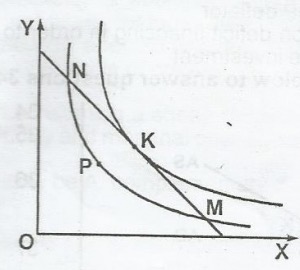
The consumer is at equilibrium at point
N
P
M
K
Correct answer is D
The consumer is at equilibrium at point K where the consumption of Y = X (intersection between Y and X).
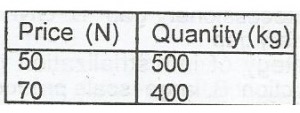
From the above, calculate the price elasticity of demand
5.0
2.0
1.0
0.5
Correct answer is A
price elasticity of demand is calculated as the;
percentage change in quantity demanded
percentage change in price
Change in quantity = 500 - 400 = 100
% change = 100/100 = 1%
Change in price = 70 - 50 = 20
% change = 20/100 = 0.2%
price elasticity = 1/0.2 = 5
N11.7 billion
N13.3 billion
N21.7 billion
N26.6 billion
Correct answer is B
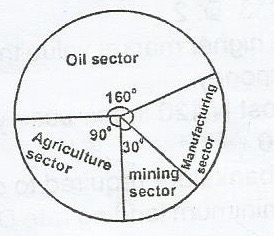
The summation of a piechart is 360°. To get the figure for manufacturing sector we simply add the figures for oil, agriculture and mining sector and minus it from 360. Thus we have;
160 + 90 + 30 = 280
360 - 280 = 80
Manufacturing sector = 80°
The difference between Oil sector and manufacturing sector =
Oil sector = 160 / 360 x 100 = 44.44%
0.444 x 60,000,000,000 = 26,640,000,000
Manufacturing sector = 80 / 360 x 100 = 22.22%
0.222 x 60,000,000,00 = 13,320,000,000
Difference 26,640,000,000 - 13,320,000,000 = 13,320,000,000
The percentage contribution of Agricultural sector is
67.5
40.0
32.4
25.0
Correct answer is D
90 / 360 x 100 = 25%
JAMB Subjects
Aptitude Tests