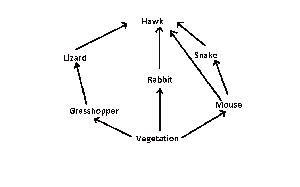
an omnivore
a primary consumer
a tertiary consumer
a scavenger
Correct answer is C
No explanation has been provided for this answer.
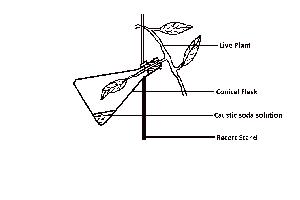
The experimental set-up can be used to demonstrate that
light is necessary for photosynthesis
oxygen is necessary for photosynthesis
photosynthesis occurs in the leaves of plants
carbon (IV) oxide is necessary for photosynthesis
Correct answer is D
No explanation has been provided for this answer.
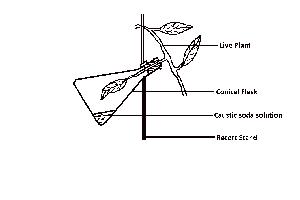
Which of the following statement is correct about the experiment?
The flask must be of the conical type
Caustic soda can be replaced with distilled water
The enclosed leaf will lose its green colour
The leaves outside the flask serve as control
Correct answer is D
No explanation has been provided for this answer.
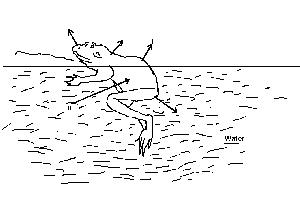
The process of water loss and intake indicated by the arrow labelled I and II are respectively
exhalation and osmosis
urination and diffusion
osmosis and diffusion
evaporation and osmosis
Correct answer is D
- Most frog species show little resistance to evaporative water loss (EWL) through their skin.
- The movement of water across membranes from areas of high concentration (lots of water) to areas of low concentration (less water) is called osmosis. The reason frogs do not have to actively drink water and instead can sit in a bowl of water and absorb water passively is due, in large part, to osmosis.
- That is, frogs do not drink like we do; they absorb water directly through their skin in an area known as the 'drinking patch' located on their belly and the underside of their thighs.
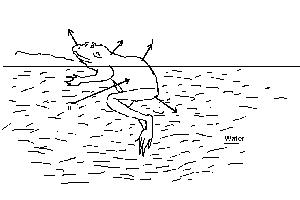
A noticeable adaptation of the animal to its aquatic habitat is the possession of
a wide mouth
large eyes
webbed digits
fore limbs
Correct answer is C
No explanation has been provided for this answer.
JAMB Subjects
Aptitude Tests