The energy in the nucleus of atoms produce heat which can be used to generate
Kinetic energy
Mechanical energy
Electrical energy
Potential energy
Correct answer is A
No explanation has been provided for this answer.
0.75 days
2.58 days
4 days
4.80 days
6 days
Correct answer is D
64g → 32g → 16g → 8g → 4g → 2g
Half life time= 24/5 = 4.8 days
Which of the following statements is not true?
Musical notes consist of the combination of sounds of regular frequency
The combination of overtones produced by an instrument determines the quality of the sound
the loudness of sound is determined by its frequency
the pitch of a note depends on the frequency of vibration of the source
Noise can be produced by a combination of sounds of irregular frequency
Correct answer is A
No explanation has been provided for this answer.
36.67m
74.25m
148.50m
297.00
366.67m
Correct answer is C
v = 2x/t ∴ distance x = vt/2 = 148.5m
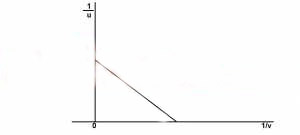
f= the slope of the graph
f= the intercept on the 1/u axis
f =the intercept on the 1/v axis
f = reciprocal of the slope
f = reciprocal of the intercept on either axes
Correct answer is E
No explanation has been provided for this answer.
JAMB Subjects
Aptitude Tests