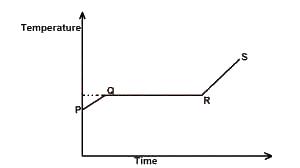
The diagram above is the heating curve for a solid, QR is the?
melting region
boiling region
sublimation region
evaporating process
Correct answer is A
At melting point there is no change temperature
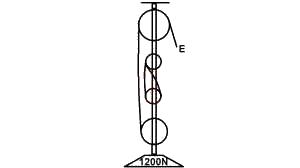
275N
325N
375N
573N
Correct answer is C
VR = No. of pulleys = 4
Efficiency = \(\frac{M.A}{V.R}\)
cross multiply
\(\frac{80}{10} * V.R\) = M.A
\(\frac{80}{10} * 4\) = M.A
M.A = 3.25
where M.A = \(\frac{load}{effort}\)
∴ Effort = \(\frac{1200}{3.2} * V.R\)
= 375N
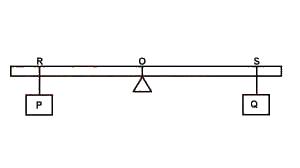
moving Q nearer to O
moving P nearer to O
addding a weight Q to Q
moving P further away from O
Correct answer is B
If 2P is added P, the beam will bend at R side. So to keep it in equilibrium. P should be moved nearer to 0
2.5 ms-1
3.0 ms-1
4.0 ms-1
4.5 ms-1
Correct answer is A
Smooth plane has negligible friction
∴ only the resultant of the perpendicular forces is acting on the body, which is given as
F =
√ 82 + 62
=
√ 64 + 36
=
√ 100
= 10N
But F = Ma
∴ a = F/M = 10/4 = 2.5 ms-1
4.0 ms-1
6.6 ms-1
12.1 ms-1
21.0 ms-1
Correct answer is C
The force which is centripetal
F = \(\frac{MV^2}{R}\)
=5 x 723.5
= 70
Since, force is 70 N when speed is 7m/s
Speed = ? when force 70N is trippled → 70 * 3 = 210N
210 = \(\frac{5×v^2}{3.5}\)
210 × 3.5 = 5 * v^2
735 ÷ 5 = v\(^2\)
v\(^2\) = 147
v =12.12m/s
JAMB Subjects
Aptitude Tests