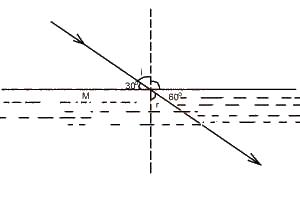
The refractive index of the medium M in the diagram above is
1/√3
2√3
√3
2/√3
Correct answer is C
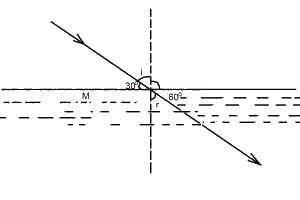
From the above diagram ; ? = 90o - 30o = 60o
v = 90 - 60 = 30
∴ refractive index = (sin ?)/(sin v) = (sin 60o / sin 30o) = √3/2/1/2
= √3/2 x 1/2
= √3
u/f - f
u/v + f
v/f + 1
v/f - 1
Correct answer is D
Magnification, M = v/u = v (1/u)
And for the Lens formula 1/u + 1/v = 1/f
=> 1/u = 1/f - 1/v
∴M = V(1/u)
= V(1/f - 1/v) = v/f - v/v = v/f - 1
∴M = v/f - 1
The pitch of a sound note depends on
timbre
frequency
harmonics
quality
Correct answer is B
No explanation has been provided for this answer.
Convex lens
Binoculars
Concave lens
Plane glasses
Correct answer is C
A person with this condition is said to be short-sighted. Hence, to correct it, a concave lens is used for correction.
What happens to the rays in a parallel beam of light?
They diverge as they travel
they intersect
They converge as they travel
They meet at infinity
Correct answer is D
No explanation has been provided for this answer.
JAMB Subjects
Aptitude Tests