40Ω
20Ω
10Ω
5Ω
Correct answer is B
Let the original length = L1
Let the original resistance = R1 = 5Ω
Let the original resistivity = P1
Let the original area = a1
Let the new length = L2 = 2L1
let the new area = a2 = 1/(2a2)
Let the new resistance = R2
Let the new resistivity = P2
But since the resistivity remains the same,
=> P1 = P2
| ∴ P1 = | R1 a1 |
| _L1 |
| = P2 = | R2 a2 |
| _L2 |
But a2 = 1/2a1; and L2 = 2L1
| ∴ | R1 a1 |
| _L1 |
| = | R2 2a1/2 |
| _2L1 |
| => | 5 x a1 |
| _L1 |
| = | R2 x a1 |
| _4L1 |
| ∴R2 = | 5 x a1 x 4L1 |
| _a1 x L1 |
= 20Ω
The operation of an optical fibre is based on the principal of
dispersion of light
interference of light
refraction of light
polarization of light
Correct answer is C
No explanation has been provided for this answer.
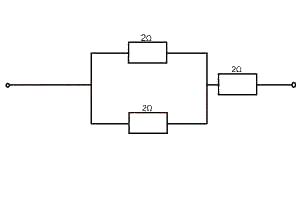
27W
18W
9W
5W
Correct answer is A
From the above diagram, if each of the resistors can dissipate a maximum of 18W, the from the relation power, P = I2R, the current in the 2Ω series resistor is given by:
I2 = P/R = 18/2 = 9 => I = √9 = 3A
The effective parallel arrangement of the two 2Ω resistors: 1/R = 1/2 + 1/2 = 1Ω
∴ Total resistance in the circuit = 1 + 2 = 3Ω
current flowing the circuit = 3A
∴ Maxi. power = P = I2R = 32 x 3 = 27W
no charge and a zero potential
a positive charge and zero potential
a negative charge and positive potential
a negative charge and a negative potential
Correct answer is D
No explanation has been provided for this answer.
1.0 x 10²m2
9. 0 x 102m2
1.0 x 10³m2
9.0 x 10⁴m2
Correct answer is A
Generally in thermal/heat conduction, if 1.2 x 10⁶ J is the heat flow per seconds; 30KM-1 is the temperature gradient of the materials; and 400Wm-1K-1 the thermal conductivity of the material, then we have that:
heat flow per seconds per unit area = thermal conductivity x temp. gradient
i.e = 1.2 x 10⁶Area
= 400 x 30
=> 400 x 30 x Area = 1.2 x 10⁶
∴ Area = 1.2 x 106400 x 30
Area = 100m2 or 1.0 x 10²m2
JAMB Subjects
Aptitude Tests