In the short-run, the monopoly makes______
Normal profit
Abnormal Profit
Loss
Sales
Correct answer is B
Short-run is a period where at least one input is fixed while others are variable.
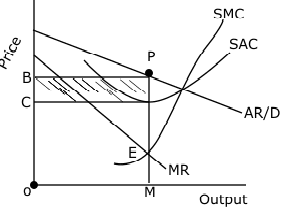
The short-run monopoly sells OM output at MP (OB) price. The total monopoly profits are AP × CA = CAPB is shaded in the diagram.
CAPB indicates an abnormal profit of the monopolist.
In a perfect competition, the market price is determined by_______
The government
The producer
The consumer
The market supply and demand junctions
Correct answer is D
Since the buyers or sellers cannot influence the price of goods and services. The Demand and Supply determined the price the firm can sell any quantity it wishes.
If two commodities are unrelated, a change in the price of one will___________
Have effect on the quantity demanded of the other
Have no effect on the quantity demanded of the other
Increase the quantity demanded on the other
Decrease the quantity demanded on the other
Correct answer is B
The two goods are Independent goods. Therefore, a change in the price of one will have no effect on the other. e.g. refrigerator and bicycle. A change in the price of refrigerator will have no effect on bicycle since they are not related.
A demand which gives rise to the reverse of the law of demand is__________
Derived demand
Joint demand
Abnormal demand
Composite demand
Correct answer is C
A normal demand curve slopes downward from left to right indication. It lower price more will be demand but Abnormal demand curve slopes upward from left to right indications, It higher price more will be demanded which give reverse.
| X | 2 | 3 | 4 | 5 |
| F | 2 | 5 | 2 | 1 |
What is the median of the distribution?
5
4
3
2
Correct answer is C
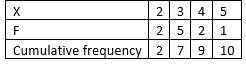
When a group data is involved, cumulative frequency is used. The formula will be: Median=[(N+1)/2]th
For member of odd number items. That is, where N is odd
Median=([N/2]th + [N/2 + 1]th)/2
For member of odd number items. That is, where N is odd
Solution:
From the table, there are 20 members as indicated by the cumulative frequency. Since the members are odd (10) the median age will be ([N/2]th + [N/2 + 1]th)/2
Median=([10/2]th + [10/2 + 1]th)/2
=(5th + 6th)/2
The 5th member is 3 and the 6th member is on 3
Median=(3 + 3)/2
=6/2
Median = 3
JAMB Subjects
Aptitude Tests