Efficiency of labour in a country is determined by the following except the____________
Social attitude to work
Education and training
Total population
Working conditions of workers
Correct answer is C
Efficiency of labour may be defined as the ability of labour to increase output without increasing the quantity of labour. Increase in efficiency is usually expressed in terms of increase in output of labour within a shorter period of time without any fall in the quality of goods and services produced. Factors which affect efficiency of labour include Education and training, attitude to work, working conditions of workers. However, total population is not a factor that affects efficiency of workers.
In a capitalist economy, factors of production are owned and controlled by the _____?
Citizen
Business Men
Government
Foreigners
Correct answer is B
Capitalism or free market economy may be defined as the type of economic system in which the means of production are owned and controlled by private individuals that is; it is characterized by private ownership of the means of production. In this case, the private individuals play a greater role than the government in taking decisions on what to produce, how to produce, for whom to produce and the distribution of what has been produced.
$2,400.00
$2,000.00
$1,200.00
$1,000.00
Correct answer is A
To calculate the budget on education, let x represent the budget on education
Total budget = $7,200
Expenditure on education = x/$7200 × 3600 = 1200
3600x = 1200 × $7200
x = 1200 × $7200/3600
x = $2,400
Therefore, the budget allocated to education is $2,400
The two major types of international trade are Bilateral trade and?
Internal trade
Multilateral trade
Dilateral trade
Trilateral trade
Correct answer is B
Multilateral trade is a type of international trade in which a country trades with many other countries. This ensures international division of labour. It is the type of trade in which many countries exchange their goods and services.
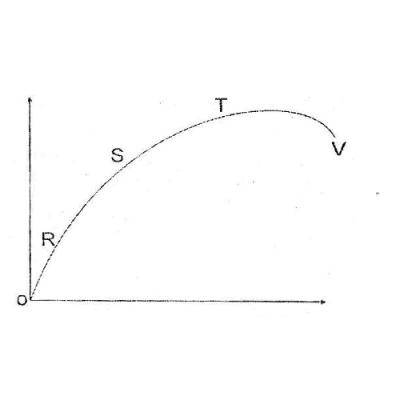
R
S
T
V
Correct answer is D
Law of diminishing returns states that as more units of a variable input are added to fixed amounts of land and capital, the change in total output will first rise and then fall. From the above diagram, diminishing returns set in at point V.
JAMB Subjects
Aptitude Tests