15.0\(^o\)C
45.0\(^o\)C
52.5\(^o\)C
60.0\(^o\)C
Correct answer is B
Time = 2mins = 2 × 60 = 120secs
Energy = power × time
1000 × 120 = 120,000J
Energy = mc(θ\(_2\) – θ\(_1\))
120,000 = 2 × 4000(θ\(_2\) – θ\(_1\))
θ2 = 30 + 15 = 45 \(^o\) C
15\(^o\)
18\(^o\)
22\(^o\)
24\(^o\)
Correct answer is C
X = \(\frac{4}{3}\) r = ?
Shell’s law:. = \(\frac{Sin i^0}{ Sin r^0}\)
= \(\frac{Sin 30^0}{Sin r^0}\)
Sin\(r^0\) = \(\frac{3 Sin 30^0}{4}\)
Sin \(r^0\) = 0.375
R \(^o\) = Sin-1 (0.375)
R \(^o\) = 22.02 \(^o\)
R \(^o\) = 22 \(^o\)
The resistance of a 40W car head lamp, drawing current from a 12V battery is ____.
0.3Ω
3.3Ω
3.6Ω
4.8Ω
Correct answer is C
Power delivered to head lamp = \(\frac{V_2}{R}\)
= 40W
R = \(\frac{V_2}{40}\)
= \(\frac{(12 × 2)}{40}\)
= 3.6Ω
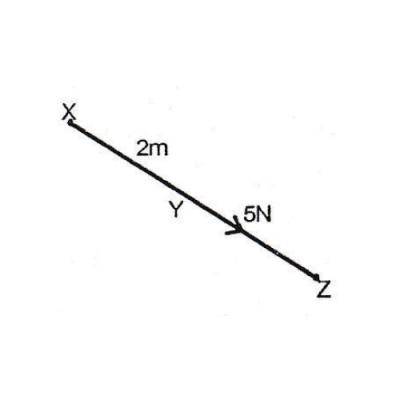
0Nm
3Nm
7Nm
10Nm
Correct answer is A
using the formular :
Moment = Force × Distance
5 X 0 = 0Nm
The energy needed to move a unit positive charge around a complete electric circuit is called the
electromotive force
electric potential difference
electric energy
kinetic energy
Correct answer is B
Electric potential difference: work needed per unit of charge to move a test charge between the two points.
Electric energy: energy derived from electric potential energy.
Kinetic energy: moving energy
JAMB Subjects
Aptitude Tests