
Chemistry questions and answers

Chemistry Questions and Answers

Learn more about the properties, composition, and structure of substances (elements and compounds) with these Chemistry questions and answers. This Test can be used by students preparing for Chemistry in JAMB, WAEC, NECO or Post UTME.
3,226.

2H2(g) + O2(g) ⇌ 2H2O(g) ΔH = -ve
what happens to the equilibrium constant of the reaction above if the temperature is increased?

A.

it is unaffected

B.

it becomes zero

C.

it decrease

D.

it increase

Correct answer is C

This given equation shows the forward reaction is exothermic, which means an increase in temperature will cause the equilibrium position to shift to left to favor reactant formation, i.e K decreases 

3,227.

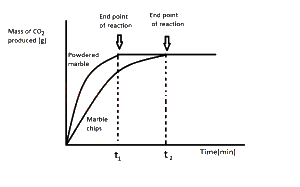
The graph above demonstrate the effect of?

A.

surface area on the rate of reaction

B.

catalyst on the rate of reaction

C.

pressure on the rate reaction

D.

concentration on the rate of reaction

Correct answer is A

No explanation has been provided for this answer.

3,228.

In the preparation of oxygen by heating KClO3 in the presence of MnO2, only moderate heat is needed because the catalyst acts by?

A.

lowering the pressure of the reaction

B.

increasing the surface area of the reactant

C.

increase the rate of the reaction

D.

lowering the energy barrier of the reaction

Correct answer is C

- The presence of MnO2 increase the rate of the reaction by providing a new reaction path / making more particles possess kinetic energy greater then the activation energy.

3,229.

If a reaction is exothermic and there is a great disorder, it means that?

A.

the reaction is static

B.

the reaction is in a state of equilibrium

C.

there will be a large increase in free energy

D.

there will be a large decrease in free energy

Correct answer is D

If a reaction is exothermic and there is a great disorder for a spontaneous reaction to occur, a large decrease in free energy is evident.

3,230.

In which of the following is the entropy change positive?

A.

Thermal dissociation of ammonium chloride

B.

Reaction between an acid and a base

C.

Addition of concentrated acid to water

D.

Dissolution of sodium metal in water

Correct answer is A

Thermal dissociation of ammonium chloride is an endothermic reaction as heat is absorbed for a positive entropy, with more products than reactants.