
Economics Questions and Answers
Economics questions and answers to help you prepare for JAMB, WAEC, NECO, Post UTME and job aptitude tests or interviews.
Economics questions and answers to help you prepare for JAMB, WAEC, NECO, Post UTME and job aptitude tests or interviews.
Completely competitive market exist when each member is a —
Price maker
Price taker
Price seeker
A and B
Correct answer is B
A perfect market may be defined as one in which buyers or sellers cannot influence the price of goods and services. That is, the buyers or sellers are price taker since there exist a common price for commodities throughout the market.
\(\frac{∑f(x-x̄)}{N}\) Is a formula used to calculate for ____________
Variance
The Quartile
Standard deviation
Mean deviation
Correct answer is D
where;
N = number of items in the distribution
X = is variable
x̄ = Arithmetic mean
∑ = sum of
Other products gotten from Petroleum include the following EXCEPT
Rubber
Fuel
Paints
Insecticides
Correct answer is A
Rubber is a coagulated, elastic latex. Plants that produce elastic latexes are largely neotropical. Commercial rubber is produced from latex of Hevea brasiliensis.
Which of the following institutions does not operate in the money market?
Central bank
Mortgage banks
Money deposit banks
Insurance companies
Correct answer is B
This question is a little bit tricky to answer because out of the 4 options provided only one is not a
participant in the (Nigeria) money market and that is the mortgage banks because mortgage loans
are usually not in short term of say 13months which makes it not fit into the money market characterized by short term loans. The central bank, Money deposit bank and insurance companies
are all participant of the money market because they offer short term loans.
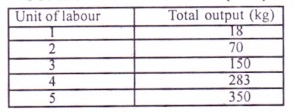
From the table above, the average product of the 3rd unit of labour is
50
70
350
150
Correct answer is A
This is because the average product (AP) is found by dividing total product by the input of labour. For example, a company that produce 100kg of product with 10 workers has an average product of 10.
For a detailed explanation, taken a company A for example. If company A employs only one worker and with one worker, total production is 20kg each hour. This gives an average product of 20kg. Now if company A employs two workers and the total production is 50kg, the average product for the two workers give 25kg. Also when company A employs three workers and the total hourly production increase to 90kg, these means 30kg is the average product for the three workers and so on.
In this case, 3 workers produce 150kg of output therefore, the Average product of labour for the 3rd unit is 50kg. Given by:
Average product= TextTotalproduct/TextVariableproduct