
Physics Questions and Answers
If you want to learn more about the nature and properties of matter and energy or you're simply preparing for a Physics exam, these Physics past questions and answers are ideal for you.
If you want to learn more about the nature and properties of matter and energy or you're simply preparing for a Physics exam, these Physics past questions and answers are ideal for you.
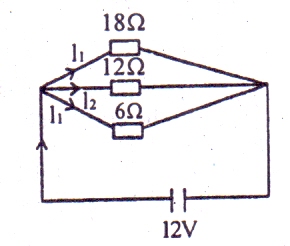
From the diagram above, calculate the total current in the circuit
5.0A
3.7A
4.5A
4.0A
Correct answer is B
V = IR from ohms law
I = \(\frac{V}{R}\)
Since the resistance are in parallel
\(\frac{1}{Reff}\) = \(\frac{1}{8}\) + \(\frac{1}{12}\) + \(\frac{1}{6}\)
= \(\frac{2 + 3 + 6}{36}\) = \(\frac{11}{36}\)
Reff = \(\frac{36}{11}\) = 3.27
I = I1 + I2 + I3
= \(\frac{V}{Reff}\)= \(\frac{12}{3.27}\)
= 3.669A
I = 3.7A
N80.00
N45.36
N65.00
N57.12
Correct answer is D
Seven 40W lamps = 7 × 40 = 280W
Five 80W lamps = 5 × 80 = 400W
Total power = 280W + 400W
= 680W
= \(\frac{680KW}{1000}\) = 0.68KW
The kilowatt hour = 0.68 KW × 12 hrs
= 8.16 KWh
Cost is N 7 per KWh
So the cost of running them = 8.16KWh × N 7/KWh
= 57.12
38o
19.47o
16.25o
49o
Correct answer is A
For a refractive index () = \(\frac{\sin\frac{1}{2} (A + D)}{\sin\frac{1}{2}A}\)
D = angle of minimum deviation
A = refractive angle of the prism
1.5 = \(\frac{\sin\frac{1}{2} (60 + D)}{\sin\frac{1}{2} \times 60}\)
1.5 = \(\frac{\sin\frac{1}{2} (60 + D)}{\sin 30}\)
Sin \(\frac{1}{2}\) (60 + D) = 1.5 * Sin 30
Sin \(\frac{1}{2}\) (60 + D) = 0.75
\(\frac{1}{2}\) (60 + D) = Sin-1 (0.75)
but Sin-1 (0.75) = 49o
\(\frac{1}{2}\) (60 + D) = 49
60 + D = 2 * 49 = 98o
D = 98o - 60o
D = 38o
If silicon is doped with phosphorus, what type of semiconductor material will be formed?
Zener material
P-n junction
n-type
p-type
Correct answer is C
When silicon is doped with a trivalent atom. A p-type semi-conductor will be formed when silicon is doped with a pentavalent atom such as arsenic, a n-type semi-conductor will be formed
Phosphorous is a pentavalent element, so it will produce a o -type semi-conductor
5
4
3
2
Correct answer is C
When two mirror are inclined at an angle θ, the number of images formed, n = \(\frac{360}{\theta}\) − 1
∴ since \(\theta\) = 90o
∴ \(\frac{360}{\theta}\) − 1
= 4 − 1
= 3