Pyrometer thermometer
Platinum resistance thermometer
Thermocouple thermometer
Constant pressure gas thermometer
Correct answer is A
A pyrometer is a type of remote-sensing thermometer used to measure the temperature of a surface. It does this by measuring the thermal radiation or infrared energy being emitted from the object. Therefore, a pyrometer thermometer measures temperature from the thermal radiation emitted by objects.
6680 J
1680 J
7520 J
7940 J
Correct answer is D
Quantity of heat required to raise the temperature of the ice cube from \(-10^oC\) to \(0^oC\)
⇒H=mc►ø = 0.02 × 2100 × 0 -(-10)
⇒ H = 0.02 × 2100 × (0 + 10) = 0.02 × 2100 × 10
⇒ H = 420 J
quantity of heat required to melt ice at \(0^oC\)
⇒ H = mL = 0.02 × 3.34 × \(10^5\)
⇒H=6680 j
Quantity of heat required to raise the temperature of the melted ice cube (water) from \(0^oC\) to \(-10^oC\)
⇒H=mc►ø = 0.02 × 4200 × (10-0)
⇒H = 0.02 × 4200 × 10
⇒H = 840j
;420 + 6680 + 840 = 7940 j
3.54nC
42.5nC
35.4nC
4.25nC
Correct answer is B
A= \(0.8m^2\) d= 20mm =\(\frac{20}{1000}\) = 0.02m
v =120v; \(ε_oA\)= \(8.85 × 10^-12 fm^-1\)
C = \(\frac{ε_oA}{d}\)
C =\(\frac{8.85 × 10^-12×0.8}{0.02}\)
C= \(3.54 × 10^-10 F\)
Q= CV
⇒ \(3.54 × 10^-10\) × 120 = \(4.25×10^-8c\)
Q=\(42.5 × 10^-9c\) = 42.5nC
6.43 cm
8.24 cm
4.26 cm
5.82 cm
Correct answer is D
\(r_1\) = 4.5cm , \( P_1\) =is the total pressure on the bubble at a depth of 12m from the surface.
\(P_1\) = 12 + 10.34 =22.34m
\(V_1\) = \(\frac{4}{3}\)π× \(r^3_1\)
= \(\frac{4}{3}× π×{4.5^3cm^3}\)
\(P_2\) = 10.34m
\(V_2\) = \(\frac{4}{3} {π}{r^3_2}\)
from boyles law:
\(P_1V_1\) = \(P_2V_2\)
⇒ 22.34× \(\frac{4}{3}× π×{4.5^3}\) = 10.34 × \(\frac{4}{3}×π×{r^3_2}\)
⇒ 22.34 × \(4.5^3\) = 10.34 × \(r^3_2\)
⇒ \(r^3_2 = \sqrt[3]{196.88}\)
⇒ \(r_2\) = 5.82cm
250
300
450
200
Correct answer is A
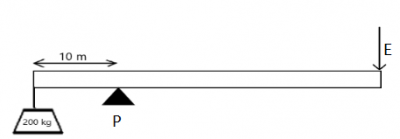
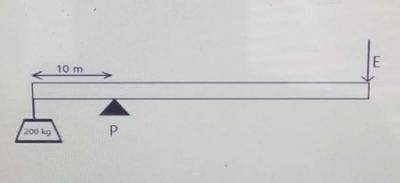
ε= 80%, L=200× 10 = 2000N, \(d_L\)=10m
\(d_E\)= 110-10 = 100m, E=?
ε = \(\frac{work done on the load}{work done by the effort}\) × 100%
⇒ work done on load = 2000 ×10 =20,000 j
⇒ work done by effort = E × 100 = 100E
⇒ 80 = \(\frac{20,000}{100E}\) × 100%
⇒ 80 = \(\frac{20,000}{E}\)
⇒ E = \(\frac{20,000}{80}\)
⇒ E = 250N
JAMB Subjects
Aptitude Tests