Which of the compounds is composed of Al, Si, O and H?
Epson salt
Limestone
Clay
Urea
Correct answer is C
Between the five main minerals found in clay, kaolinite is the most common. Kaolinite holds the chemical composition Al\(_{2}\) Si\(_{2}\)O\(_{5}\)(OH)\(_{4}\) and is an aluminum silicate material with a low “shrink-swell” capacity. It is a soft, white mineral but is often colored orange or red by iron oxide found in the soil.
H\(_2\)S
S
HCl
Cl\(_2\)
Correct answer is D
H \(_2\) S + Cl \(_2\) → 2HCl + S
Please note: substance oxidized or reduced are always the reactants. So, one can easily cross out the two products.
Reduction is
1. Addition of hydrogen
2. Removal of Oxygen
3. Addition of Electron
Oxidation is
1. Removal of hydrogen
2. Addition of hydrogen
3. Removal of Electron
From the question we can see that H was added to Cl in the product, thereby making hydrogen to be removed from S in the reactant hence S is oxidized as a result of the removal of hydrogen and Cl \(_2\) has been reduced due to addition of hydrogen.
Cl \(_2\) is reduced
The elements in the periodic table are listed in order of increasing
relative atomic number
atomic mass
relative isotopic mass
nuclear charge
Correct answer is A
The periodic number table is arranged in order of atoms increasing atomic number
The alkanoic acid found in human sweat is
CH\(_3\)-COOH
CH\(_3\)—CH\(_2\)—COOH
H-COOH
CH\(_3\)
Correct answer is B
Bacteria of the genus Propionibacterium produce propionic acid (Propanoic Acid) as the end-product of their anaerobic metabolism. This class of bacteria is commonly found in the stomach of ruminants and the sweat glands of humans, and their activity is partially responsible for the odour of both Swiss cheese and sweat.
The situation obtained when a perfect gas expands into a vacuum is
ΔH is positive and TΔ S is zero
ΔH is positive and T Δ S is negative
ΔH is negative and TΔ S is zero
ΔH is zero and T Δ S is positive
Correct answer is D
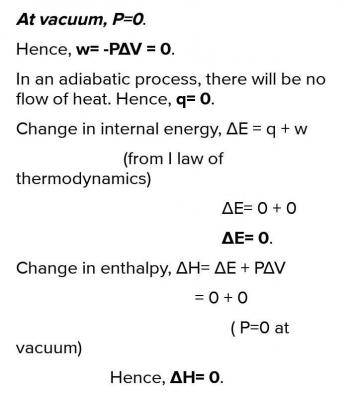
The definition of enthalpy change is
ΔH = ΔU + Pex(ΔV)
The enthalpy change is zero because both terms on the right are zero in free expansion of an ideal gas.
There is no external pressure in a free expansion, so P (ex) = 0. And the internal energy change, ΔU of free expansion in a closed system is zero since no inter molecular forces have to be overcome. The temperature remains constant and no heat is absorbed or released.
JAMB Subjects
Aptitude Tests