Simplify: \(\sqrt{108} + \sqrt{125} - \sqrt{75}\)
\(\sqrt{3} + 5\sqrt{5}\)
\(6 \sqrt{3} - 5 \sqrt{5}\)
\(6 \sqrt{3} + \sqrt{2}\)
\(6\sqrt{3} - \sqrt{2}\)
Correct answer is A
\(\sqrt{108} + \sqrt{125} - \sqrt{75}\)
= \(\sqrt{3 \times 36} + \sqrt{5 \times 25} - \sqrt{3 \times 25}\)
= \(6 \sqrt{3} + 5 \sqrt{5} - 5 \sqrt{3}\)
= \(\sqrt{3} + 5\sqrt{5}\)
Add 54 \(_{eight}\) and 67\(_{eight}\) giving your answers in base eight
111
121
123
143
Correct answer is D
54 \(_{eight}\) and 67\(_{eight}\) = 1438
Starting with normal addition, 4 + 7 gives 11
(it is more than the base, 8) 8 goes in 11 just 1 time, remaining 3, the remainder will be written, and the 1 will be added to the sum of 5 and 6 which gives 12 altogether, 8 goes in 12 one time remaining 4, the remainder 4 was written and then the 1 that was the quotient was then written since nothing to add the 1 to.
So answer is 143 in base eight
026\(^o\)
045\(^o\)
210\(^o\)
240\(^o\)
Correct answer is D
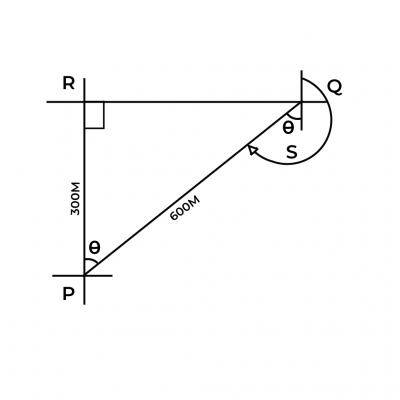
Cos θ = \(\frac{adj}{hyp}\)
= \(\frac{300}{600}\)
= 0.5
θ = Cos - 10.5
= 60
∠ RPQ = ∠ PQs
So the bearing of P from Q is 180 + 60 = 240\(^o\)
Answer is D
Simplify 25\(\frac{1}{2}\) × 8\(\frac{-2}{3}\)
1\(\frac{1}{4}\)
2\(\frac{1}{4}\)
6
10
Correct answer is A
Using law of indices
25\(\frac{1}{2}\) × 8\(\frac{-2}{3}\)
= √25 x (\(\sqrt[3]{8}\)) -2
= 5 x 2-2
= 5 x \(\frac{1}{2^2}\) =
\(\frac{5}{4}\) = \(\frac{11}{4}\)
Answer is A
Approximate 0.9875 to 1 decimal place.
1.1
1.0
0.9
0.10
Correct answer is B
9 is on one decimal place, the next number to it is 8 which will be rounded up to 1 because it is greater than 5 and then added to 9 to give 10, 10 cannot be written, it will then be rounded up to 1 and added to 0. So the answer is 1.0
JAMB Subjects
Aptitude Tests