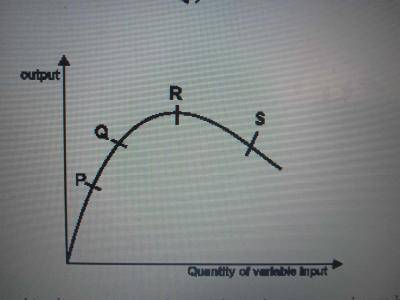
At what point on the total product curve shown above will marginal product be negative?
Q
S
R
P
Correct answer is B
Marginal product is negative at point S on the total product curve. This is because the total product curve is decreasing at point S. When the total product curve is decreasing, the marginal product is negative.
The marginal product is the additional output that is produced when one additional unit of input is added. In this case, the additional output is decreasing, so the marginal product is negative.
The other points on the total product curve, P, Q, and R, are all increasing. Therefore, the marginal product is positive at these points.
To overcome the problem of double counting under the expenditure approach
Spending on intermediate goods and inputs are considered
Valued added method is used
Proper accounting standards must be used
Only spending on final goods are considered
Correct answer is D
To overcome the problem of double counting under the expenditure approach, only spending on final goods are considered.
The expenditure approach to calculating national income measures the total spending on goods and services in an economy. However, this can lead to double counting, as the same good or service can be counted multiple times if it is used in the production of other goods and services.
To avoid double counting, only spending on final goods is considered when using the expenditure approach. Final goods are goods and services that are not used to produce other goods and services. Intermediate goods, on the other hand, are goods and services that are used to produce other goods and services.
By only considering spending on final goods, the problem of double counting is avoided. This is because final goods are not used to produce other goods and services, so they are not counted multiple times.
A government may cause a favourable change in her invisible trade account by
Developing tourism and other services
Imposing high tariff on exports
Encouraging people to go for medical treatment abroad
Increasing the export of her primary products
Correct answer is A
A government may cause a favourable change in her invisible trade account by developing tourism and other services. Invisible trade account records the movement of services across borders. It includes items such as tourism, transportation, insurance, and royalties.
A government can promote tourism and other services by:
- Investing in infrastructure, such as airports, hotels, and tourist attractions.
- Promoting the country as a tourist destination.
- Providing incentives to businesses that provide services to foreigners.
These measures can help to increase the number of tourists and other service providers in the country, which can lead to a favourable change in the invisible trade account.
Industries are sometimes located in areas which are not profitable so as to
Encourage rural-urban migration
Be able to even-out development
Bring about external economies of scale
Be able to reap internal economies of scale
Correct answer is B
Industries are sometimes located in areas which are not profitable so as to even-out development. This is a government policy that aims to reduce regional disparities in economic development.
By locating industries in less developed areas, the government hopes to create jobs and boost economic growth in these areas. This can help to reduce poverty and improve the standard of living in these areas.
The supply of light could be met using a candle, lantern and gas lamp. This is an example of a
Complementary supply
Abnormal supply
Joint supply
Composite supply
Correct answer is A
The supply of light could be met using a candle, lantern, and gas lamp is an example of joint supply. This is because the three products are produced together and cannot be produced separately.
In joint supply, two or more products are produced from the same input. The products are said to be jointly supplied because they are produced simultaneously and cannot be produced separately.
For example, in the case of the supply of light, the three products are candles, lanterns, and gas lamps. These products are produced from the same input, which is fuel. The products cannot be produced separately because they all require fuel to be produced.
WAEC Subjects
Aptitude Tests