55\(\frac{1}{3}\)%
60%
65%
66\(\frac{2}{3}\)%
Correct answer is D
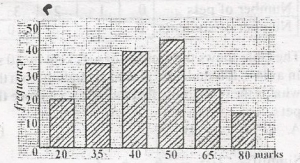
Percentage of students with marks ranging from 35 to 50 = \(\frac{f_{35} + f{40} + f{50}}{\sum f}\)
= \(\frac{35 + 40 + 45}{20 + 35 + 40 + 45 + 25 + 15}\) x 100%
= \(\frac{120}{180}\) x 100%
= 66\(\frac{2}{3}\)%
100
85
80
70
Correct answer is B
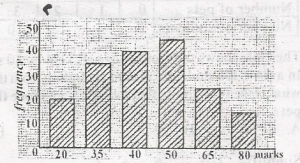
Pass mark = 50%
No. of students that passed = f50 + f65 + f80
= 45 + 25 + 15
= 85
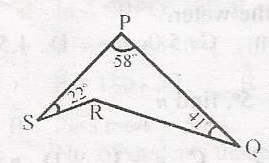
In the diagram, < PSR = 220o, < SPQ = 58o and < PQR = 41o. Calculate the obtuse angle QRS.
90o
100o
121o
60o
Correct answer is C
Joining SQ. In \(\bigtriangleup\) SPQ,
(22o + a) + 55o + (41o + b) = 180o
121o + a + b = 180o
a + b = 180 - 121
a + b = 59o.....(1)
In \(\bigtriangleup\) SRPQ; R + a + b = 180o
R + 59o = 180o
(in (1), a + b = 59o)
R = 180 - 59
R = 121o
\(\frac{3}{32}\)
\(\frac{7}{3}\)
\(\frac{5}{3}\)
\(\frac{5}{16}\)
Correct answer is D
Pr. (winning 100m race) = \(\frac{1}{8}\)
Pr. (losing 100m race) = 1 - \(\frac{1}{8}\) = \(\frac{7}{8}\)
Pr. (winning high jump) = \(\frac{1}{4}\)
Pr. (losing high jump ) = 1 - \(\frac{1}{4}\) = \(\frac{3}{4}\)
Pr. (winning only one) = Pr. (Winning 100m race and losing high jump) or Pr.(Losing 100m race and winning high jump)
= (\(\frac{1}{8} \times \frac{3}{4}\)) + (\(\frac{7}{8} \times \frac{1}{4}\))
= \(\frac{3}{32} + \frac{7}{32}\)
= \(\frac{10}{32}\)
= \(\frac{5}{16}\)
The mean of the numbers 2, 5, 2x and 7 is less than or equal to 5. Find the range of the values of x
x \(\leq\) 3
x \(\geq\) 3
x < 3
x > 3
Correct answer is A
mean \(\leq\) 5; \(\frac{2 + 5 + 2x + 7}{4}\) \(\leq\) 5
= \(\frac{14 + 2x}{4} \leq 5\)
= 14 + 2x \(\leq\) 5 x 4
14 + 2x \(\leq\) 20 ; 2x \(\leq\) 20 - 14
2x \(\leq\) 20 - 14
2x \(\leq\) 6
x \(\leq\) \(\frac{6}{2}\)
x \(\leq\) 3
WAEC Subjects
Aptitude Tests