The sagging of overhead electrical wires is caused by
radiation of heat.
rough handling.
gravitational attraction
Linear expansion
Correct answer is D
The sagging of overhead electrical wires is caused by linear expansion.
Linear expansion is the tendency of materials to expand in length when they are heated. When overhead electrical wires are heated by the sun, they expand and sag.
A direct current cannot pass through a parallel plate capacitor because
the plates are non-conducting.
the dielectric between the plates is non-conducting.
there is a leakage of charge from the plates.
the plates have equal but opposite charges.
Correct answer is B
A direct current (DC) cannot pass through a parallel plate capacitor because the dielectric between the plates is non-conducting.
In a parallel plate capacitor, two conductive plates are separated by a dielectric material (usually an insulator). When a voltage (potential difference) is applied across the plates, it creates an electric field between them, which stores electrical energy in the form of electric potential. The dielectric material between the plates is a non-conducting material, which means it does not allow the flow of electric current. Therefore, in a DC circuit, where current is the flow of charge over time, current cannot flow through the dielectric. Instead, the dielectric serves to store energy in the electric field between the plates without allowing the passage of charge.
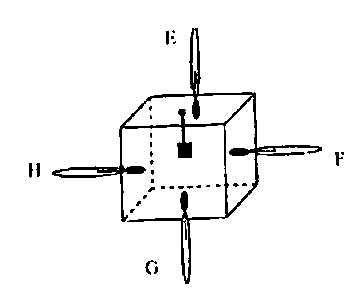
G
F
H
E
Correct answer is D
Thermometer E would register the highest temperature since the hot metal is suspended from its side
4.5Ω
5Ω
1Ω
4Ω
Correct answer is A
E = 2V, r = 0.5Ω, I = 0.4A, P = ?
E = I( R + r )
R = \(\frac{ E}{I} - r \)
R = \(\frac{ 2}{0.4} - 0.5\)
R = 5 - 0.5 = 4.5Ω
massive body has a higher momentum.
massive body builds up a higher velocity.
lighter body has a higher momentum.
momenta of both bodies remain the same.
Correct answer is D
When a lightweight body and a massive body are acted upon by the same force for the same time, the momenta of both bodies remain the same.
Given that the momenta of both the heavy and light bodies are the same, it follows that the light body possesses a higher velocity compared to the heavy body.
WAEC Subjects
Aptitude Tests