
Which of the illustrated graphs above represents a body moving with uniform retardation?
A
B
C
D
Correct answer is D
If a body moves with uniform retardation, the velocity-time graph is a straight line.
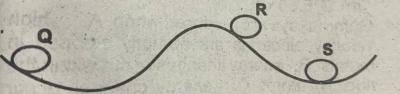
S only
Q only
R only
Q and S only
Correct answer is A
A system is in neutral equilibrium if its equilibrium is independent of displacements from its original position. A marble S on a flat horizontal surface is an example.
\(\gamma\)=a
\(\gamma\)=3\(\alpha\)
\(\gamma\)=2a
\(\gamma\)=\(\frac{1}{3} \alpha \)
Correct answer is B
cubic and linear expansivity are related by this equation. γ=3α.
0.5\(\pi\)
2
2\(\pi\)
4
Correct answer is B
The period of a simple pendulum is doubled, when its length is made four times.
density
mass
weight
volume
Correct answer is C
Archimede's Principle states that a body immersed in a fluid experiences an upthrust equal to the weight of the fluid displaced, and this is fundamental to the equilibrium of a body floating in still water.
WAEC Subjects
Aptitude Tests