The public sector in a mixed economy is not always because of
Bureaucratic practice
The desire to make huge change
Annual planning of activities
The activities of shareholders
Correct answer is A
No explanation has been provided for this answer.
Organization and entrepreneurship are vested in diferrent persons in a
Cooperative society
Sole proprietorship
Partnership
Public company
Correct answer is D
No explanation has been provided for this answer.
| Units of quantity consumed | Total utility | Marginal utility |
| 0 | - | - |
| 1 | 10 | 10 |
| 2 | 15 | 5 |
| 3 | 17 | 2 |
| 4 | 18 | 1 |
| 5 | 18 | 0 |
The table above illustrates the law of?
Diminishing returns
Diminishing marginal productivity
Diminishing marginal utility
Variable proportion
Correct answer is C
The law of diminishing marginal utility explains that all things being the same, as consumption increases, the marginal utility derived from each additional unit of a commodity declines.
What this means is that, as you consume a particular commodity, the satisfaction derived from it increases, but it gets to a point where additional consumption of that particular product will no longer give you as much satisfaction as the first few ones you consumed.
From the table above, the consumer started from 1 unit to five units, and at first, the total utility derived from consuming the product was rising from 10 -> 15 -> 17 -> 18 and remained at 18
However, the marginal utility kept declining after consuming the first unit. It moved from 10 -> 5 -> 2 -> 1 -> 0
The table below shows the short-run cost of a firm. Use it to answer the question below
| Quantity (kg) | Fixed cost ($) | Variable cost ($) | Total cost ($) | Marginal cost ($) | Average cost ($) |
| 1 | 750 | 200 | 950 | - | 950 |
| 2 | 750 | 560 | 1310 | 360 | 655 |
| 3 | 750 | 900 | P | Q | 550 |
Calculate the value of Q
$350
$340
$360
$370
Correct answer is B
To get Q, we first have to solve for P, hence we have;
Total cost (P) = fixed cost + variable
750 + 900 = 1650
Marginal cost (Q) = 1650 - 1310 = 340
| Quantity (kg) | Fixed cost ($) | Variable cost ($) | Total cost ($) | Marginal cost ($) | Average cost ($) |
| 1 | 750 | 200 | 950 | - | 950 |
| 2 | 750 | 560 | 1310 | 360 | 655 |
| 3 | 750 | 900 | 1650 | 340 | 550 |
The figure above shows the change in demand for Commodity X which is a normal good. Use it to answer the question that follows.
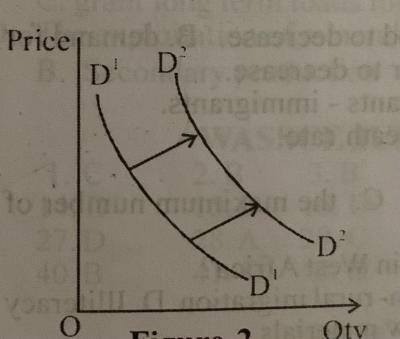
Which of the following caused the change in demand from D\(_{1}\) D\(_{1}\) to D\(_{2}\)D\(_{2}\)
Fall in the income of consumers
Rise in the price of a substitute
Rise in the price of a complement
Fall in the supply of commodity
Correct answer is B
No explanation has been provided for this answer.
WAEC Subjects
Aptitude Tests