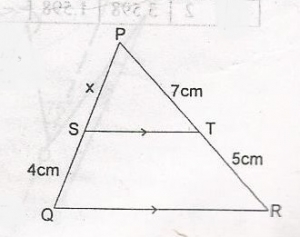
In the diagram, \SQ\ = 4cm, \PT\ = 7cm. /TR/ = 5cm and ST//OR. If /SP/ = xcm, find the value of x
5.6
6.5
6.6
6.8
Correct answer is A
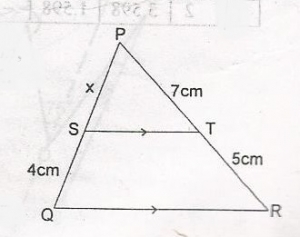
\(\frac{/PS/}{/PQ/} = \frac{/PT/}{/PR/}\)
\(\frac{x}{4 + x} = \frac{7}{7 + 5}\)
\(\frac{x}{4 + x} = \frac{7}{12}\)
(2x = 7)(4 + x); 12x = 28 + 7x
12x - 7x = 28
5x = 28
x = \(\frac{28}{5}\)
x = 5.6
legislative power
exclusive power
concurrent power
judicial power
Correct answer is C
Concurrent power is a political power independently exercisable by both federal and state governments in the same field of legislation.
Confederal systems of government means
powerful centre and weak component units
weak centre and powerful component units
powerful centre and powerful component units
weak component units and weak centre
Correct answer is B
Confederal system is a system of organisation in which there is a union of states with each member state retaining some independent control over both internal and external affairs. The component units that make up the confederation are stronger than the center
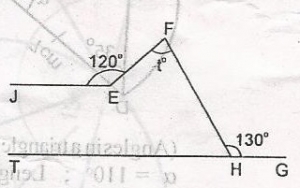
In the diagram, IG is parallel to JE, JEF = 120o and FHG = 130o, fins the angle marked t
40o
70o
80o
100o
Correct answer is B
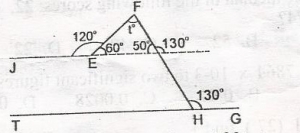
Now, t + 60o + 50o = 180o
t = 180o - 110o
t = 70o
Which of the following systems of government operates on the checks and balances?
Theocracy
Presidential
Parliamentary
Monarchical
Correct answer is B
A presidential system is a democratic and republican system of government in which a head of government leads an executive branch that is separate from the legislative branch. There is separation of power where one arm of government checks the other arm.
WAEC Subjects
Aptitude Tests