Simplify: (3\(\frac{1}{2} + 4\frac{1}{3}) \div (\frac{5}{6} - \frac{2}{3}\))
1\(\frac{1}{4}\)
8\(\frac{1}{2}\)
35
47
Correct answer is D
(3\(\frac{1}{2} + 4\frac{1}{3}) \div (\frac{5}{6} - \frac{2}{3}\)) = (7\(\frac{3 + 2}{6}) \div \frac{(5 - 4)}{6}\)
7\(\frac{5}{6} \div \frac{1}{6} = \frac{47}{6} \times \frac{6}{1}\) = 47
A country's constitution could be derived from the following sources except?
judicial precedents
customary sources
statutory sources
party manifestoes
Correct answer is D
The sources of a constitution are:-
- Legislature,Legal instrument,Statute and Parliamentary acts
- Historical documents
- Constitution of other countries
- Previous constitutions of the country
- Opinions,writings and commentaries of eminent legal experts and political thinkers, government authorities and committees
- Usages,Principles,Norms,Habits,Customs,Convention,Practices,Traditions,Rule of actions applicable to government- Common Law {Established and accepted patterns of behaviour of governance}
- Judicial decisions,Commentary by judiciary, Judges made maxims- Case Laws {Judge made laws}
- Decisions of constitutional assembly
- Parliamentary standing orders
- Legal doctrines and concepts
- Theory of judicial precedent
- Religious legal texts
- Equity,Justice and Good Conscience
25
30
35
45
Correct answer is B
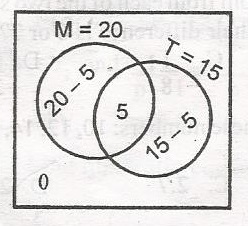
M = Mercedez; T = Toyota
Number of staff = 0 + (20 - 5) + (15 - 5) + 5
0 + 15 + 10 + 5 = 30
The fundamental law of a country refers to its?
acts of parliament
conventions
constitution
judicial precedence
Correct answer is C
Fundamental Law. Is the constitution of a state or nation; the basic law and principles contained in federal and state constitutions that direct and regulate the manner in which government is exercised.

In the diagram, find the size of the angle marked a°
60o
80o
120o
160o
Correct answer is B
2 x s = 280°(Angle at centre = 2 x < at circum)
S = \(\frac{280^o}{2}\)
= 140°
< O = 360 - 280 = 80°
60 + 80 + 140 + a = 360°
(< in a quad); 280 + a = 360
a = 360 - 280
a = 80°
WAEC Subjects
Aptitude Tests