The table below shows the effect of hormones I, II, III, and IV on some parts of the human body. Where (✓) represents effects and (X) represents no effect of hormone on the corresponding part of the body. Study it and answer this question.
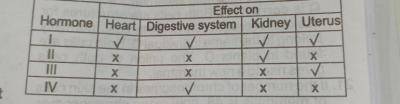
Which of the following hormones are l, II, Ill, and IV respectively?
ADH, Glucagon, Oestrogen, Adrenaline
Adrenaline, Glucagon, Oestrogen, ADH
Glucagon,ADH, Oestrogen, Adrenaline
Adrenaline, ADH, Oestrogen, Glucagon
Correct answer is B
No explanation has been provided for this answer.
Use the following processes to answer this question.
I-Ribs move upward and outward
II- Diaphragm relaxes
IIl-Volume of thorax increases
IV-Air is forced out of the lungs
which of the following processes is a direct result of contraction of the intercostal muscles?
I
II
III
IV
Correct answer is B
No explanation has been provided for this answer.
Use the following processes to answer this question.
I-Ribs move upward and outward
II- Diaphragm relaxes
IIl-Volume of thorax increases
IV-Air is forced out of the lungs
Which of the processes take place during inspiration?
I and III only
II and III only
II and III only
III and IV only
Correct answer is A
No explanation has been provided for this answer.
Which of the following blood components has the greatest affinity for oxygen and carbon (IV) oxide?
Lymphocyte
Thrombocyte
Erythrocyte
Blood plasma
Correct answer is B
No explanation has been provided for this answer.
fish and human
toad and rat
toad and fish
humans and rat
Correct answer is D
No explanation has been provided for this answer.
WAEC Subjects
Aptitude Tests