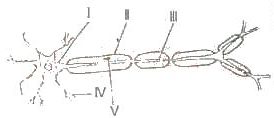
The cell body in the diagram labelled
I
II
III
IV
V
Correct answer is A
No explanation has been provided for this answer.
Which of the following explains the concave meniscus of water in a clean glass tube? the
adhension between water and glass molecules is greater than the sdhension between water molecules
cohension between water molecules is greater then the adhension between glass and water molecule
molecules of water near the glass move faster than the molecules at the centre of the tube
molecules of water at the water-air boundary are often attracted to the centre of the tube
weight of the water pulls the centre part of the surface down
Correct answer is A
No explanation has been provided for this answer.
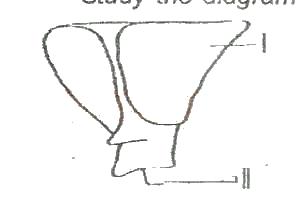
Which of the following bones forms a joint at the point labelled II in the diagram?
Humerus
Sternum
Radius
Femur
Correct answer is B
No explanation has been provided for this answer.
3.0mm
3.5mm
503.00mm
503.5mm
506.0mm
Correct answer is C
F \(\alpha\) e
F = ke
K = \(\frac{F}{e} = \frac{5}{0.5} = 10\)
when F = 30, e = \(\frac{F}{K} = \frac{30}{10} = 3\)
L = 500 + 3 = 503.00
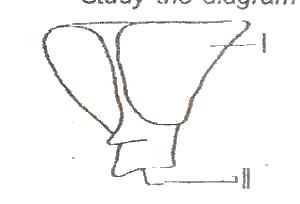
The part labelled l in the diagram is for the attachment of
ribs
biceps
shoulder muscles
the vertebral column
Correct answer is C
No explanation has been provided for this answer.
WAEC Subjects
Aptitude Tests