I,II,III
lll, I, lV, ll
lll, IV, l, ll
lV, lll, I, ll
IV, l, ll, lll
Correct answer is B
No explanation has been provided for this answer.
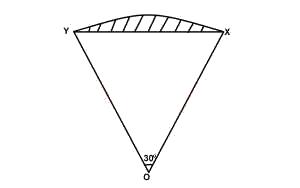
5/12cm2
7/12cm2
11/6cm2
2 1/3cm2
6 1/6cm2
Correct answer is B
Area of \(\Delta OXY\) = \(12\frac{1}{4} cm^2\)
Area of sector OXY = \(\frac{30}{360} \times \frac{22}{7} \times 7 \times 7\)
= \(\frac{77}{6} = 12\frac{5}{6} cm^2\)
Area of the shaded portion = \(12\frac{5}{6} - 12\frac{1}{4}\)
= \(\frac{7}{12} cm^2\)
The area of a parallelogram is 513cm\(^2\) and the height is 19cm. Calculate the base.
13.5cm
25cm
27cm
54cm
108cm
Correct answer is C
Area of parallelogram = base \(\times\) height.
\(513 = base \times 19 \implies base = \frac{513}{19}\)
= 27 cm
Which of the following is not true about gene mutation? It
introduces new traits into a population
causes changes in the DNA
may have unnoticeable effect on the phenotype
always affects the chromosome number
is a source of new genes
Correct answer is D
No explanation has been provided for this answer.
The volume of a cone of height 9cm is 1848cm\(^3\). Find its radius. [Take π = 22/7]
7cm
14cm
28cm
98cm
196cm
Correct answer is B
1/3 πr\(^2\) x 9 = 1848
3 x πr2 = 1848 r2 = 1848/3 x 7/22 r = 14
\(\text{Volume of a cone} = \frac{1}{3} \pi r^2 h\)
\(\frac{1}{3} \times \frac{22}{7} \times r^2 \times 9 = 1848\)
\(r^2 = \frac{1848 \times 7}{22 \times 3}\)
\(r^2 = 196 \therefore r = 14cm\)
WAEC Subjects
Aptitude Tests