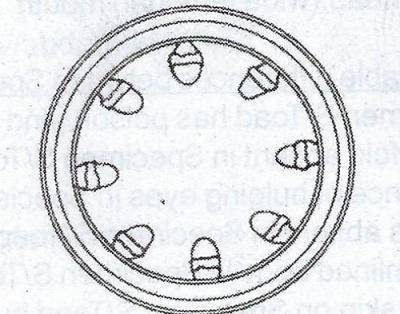
The diagram above illustrates the transverse section of a
dicotyledonous root
monocotyledonous root
dicotyledonous stem
monocotyledonous stem
Correct answer is C
The diagram shows the transverse section of a dicotyledonous stem showing its tissue distribution.
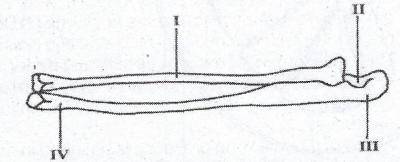
I
II
III
IV
Correct answer is C
The triceps are large muscles on the back of the upper limb of many vertebrates. The part III is a part of the bone that forms the triceps.
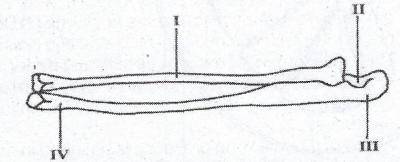
I
II
III
IV
Correct answer is B
The part II is attached to the humerus. It forms a hinge joint to make up the hand.
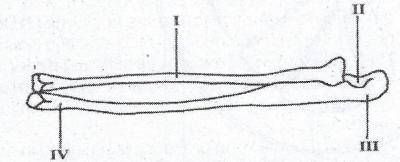
The diagram above illustrates a part of the human skeleton. It represents the bones of the
upper arm
lower arm
upper leg
lower leg
Correct answer is B
The diagram shows the lower arm which can be seen between the elbow and the wrist.
The organism that can carry out both autotropic and heterotrophic modes of nutritions is
Chlamydomonas
Eudorina
Euglena
Spirogyra
Correct answer is C
Euglena use their chloroplasts to produce nutrients through photosynthesis. It is a dual organism as it can act both as an autotroph, making its own food, and heterotroph, feeding on other substances.
WAEC Subjects
Aptitude Tests