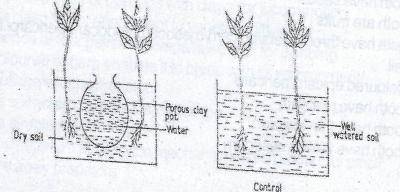
The conclusion drawn from the experiment in the diagram above is that
shoots of plants are negatively thigmotropic
shoots of plants are negatively geotropic
shoots of plants are positively phototropic
roots of plants are positively hydrotropic
Correct answer is D
The roots of the plants in diagram 1 bend towards the porous clay pot while growing and the well watered soil sees the plants growing straight and erect. The roots of the plants are positively hydrotropic (respond towards the pull of water positively).
phototropism
geotropism
hydrotropism
thigmotropism
Correct answer is C
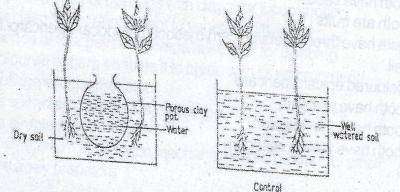
From the first diagram, you notice the roots of the plants bending towards the porous water pot, hence this is a form of response in the direction of the stimuli of the water. This is a form of hydrotropism.
Active transport differs from diffusion in that active transport
is a very fast process
allows the movement of substances against concentration gradient
takes place in both light and dark reaction of photosynthesis
occurs in both plant and animal tissues
Correct answer is B
Diffusion and osmosis depend only on the concentration gradient but active transport works against the concentration gradient.
Which of the following organelles is found only in plant cells?
Mitochondria
Ribosomes
Lysosomes
Plastids
Correct answer is D
Plastids are found only in plants and algae. One common type of plastid is the chloroplast.
The streaming movement of the cytoplasm within the Paramecium is known as
Transpiration
Digestion
Cyclosis
Osmosis
Correct answer is C
Cyclosis is also called Cytoplasmic streaming. It is defined as the streaming rotary motion of the protoplasm within certain cells and unicellular organisms. Paramecium is an example of a unicellular organism.
WAEC Subjects
Aptitude Tests