Chemistry questions and answers

Chemistry Questions and Answers

Learn more about the properties, composition, and structure of substances (elements and compounds) with these Chemistry questions and answers. This Test can be used by students preparing for Chemistry in JAMB, WAEC, NECO or Post UTME.
2,246.

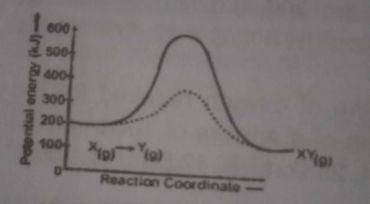
The above diagram gives the potential energy profile of the catalyst and uncatalysed reactions of X(g) + Y(g) → XY(g). Deduce the respective activation energies in KJ of the catalysed and uncatalysed reverse reactions: XY(g) → X(g) + Y(g)

A.

300, 500

B.

500, 300

C.

-300, -500

D.

-500, -300

Correct answer is C

The uncatalysed reverse reaction = 100 - 400 = -300 The calalysed reverse reaction = 100 - 600 = - 500

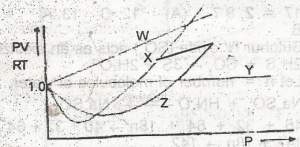
2,247.

Which of the curves in the above graph illustrates the behaviour of an ideal gas?

A.

W

B.

X

C.

Y

D.

Z

Correct answer is C

No explanation has been provided for this answer.

2,248.

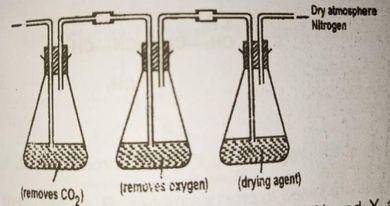
In the above set up substances X and Y are respectively

A.

lime water copper (ll) tetraoxosulphate (lV)

B.

potassium trioxocarbonate and alkaline pyrogallol

C.

potassium hydroxide and alkaline pyrogallol

D.

potassium trioxocarbonate (lV) and concentrated tetraoxosulphate (IV) acid

Correct answer is C

No explanation has been provided for this answer.

2,249.

It can be deduced from the vapour pressure curves above that

A.

liqiud 1 has the highest boiling point

B.

liquid ll has the highest boiling point

C.

liquid lll has the highest boiling point

D.

liquid lll has the lowest boiling point

Correct answer is C

Trace the iii curve horizontally and you have over 20°C temperature

2,250.

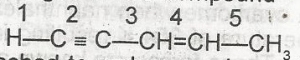
The acidic hydrogen in the compound is the hydrogen attached to carbon number

A.

5

B.

4

C.

3

D.

1

Correct answer is D

No explanation has been provided for this answer.