Chemistry questions and answers

Chemistry Questions and Answers

Learn more about the properties, composition, and structure of substances (elements and compounds) with these Chemistry questions and answers. This Test can be used by students preparing for Chemistry in JAMB, WAEC, NECO or Post UTME.
2,226.

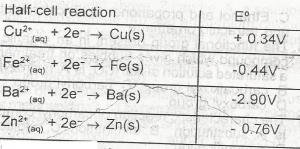
Half-cell reaction. From the data above , it can be deduced that the most powerful reducing agent of the four metals is

A.

Cu

B.

Fe

C.

Ba

D.

Zn

Correct answer is C

Elements with lower electrode potentials are most likely to be reduced and act as a reducing agent. Lower electrode potential indicates a greater tendency to accept electrons.

2,227.

For which salt in the graph above does the solubility increase most rapidly with rise in temperature?

A.

CaSO4

B.

KNO3

C.

NaCl

D.

KCl

Correct answer is B

For many solids that are dissolved in water or any liquid, the solubility increases with a temperature rise. With an increase in kinetic energy, the solvent molecules effectively break apart the solute molecules that are held together by strong intermolecular attractions, and thereby solubility is increased.

2,228.

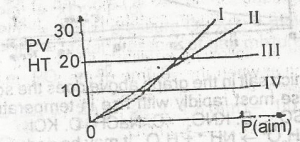
Which of the curves above represents the behaviour of 1 mole of an ideal gas?

A.

l

B.

ll

C.

lll

D.

lV

Correct answer is C

No explanation has been provided for this answer.

2,229.

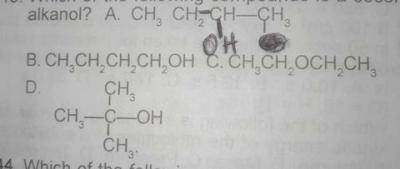
Which of the following compounds is a secondary alkanol?

A.

A

B.

B

C.

C

D.

D

Correct answer is A

Alkanols with two alkyl groups attached to the carbon atom carrying the hydroxyl group is called secondary alkanol

2,230.

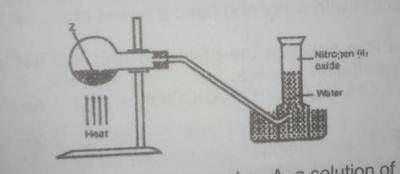
In the experiment above. Z can be

A.

a solution of sodium dioxonitrate (lll) and ammonium chloride

B.

a solution of lead trioxnitrate (V)

C.

a solution of sodium trioxonitrate (V) and ammonium chloride

D.

concentrated tetraoxosulphate (VI) acid and sodium trioxonitrate (V)

Correct answer is C

Nitrogen(I) oxide(laughing gas) can be prepared in the laboratory by the action of heat on a mixture of sodium trioxonitrate (V) and ammonium chloride, this colourless gas is collected over water.