
How good are you with figures and formulas? Find out with these Mathematics past questions and answers. This Test is useful for both job aptitude test candidates and students preparing for JAMB, WAEC, NECO or Post UTME.
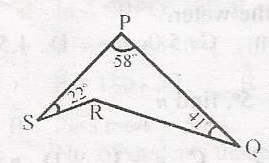
In the diagram, < PSR = 220o, < SPQ = 58o and < PQR = 41o. Calculate the obtuse angle QRS.
90o
100o
121o
60o
Correct answer is C
Joining SQ. In \(\bigtriangleup\) SPQ,
(22o + a) + 55o + (41o + b) = 180o
121o + a + b = 180o
a + b = 180 - 121
a + b = 59o.....(1)
In \(\bigtriangleup\) SRPQ; R + a + b = 180o
R + 59o = 180o
(in (1), a + b = 59o)
R = 180 - 59
R = 121o
\(\frac{3}{32}\)
\(\frac{7}{3}\)
\(\frac{5}{3}\)
\(\frac{5}{16}\)
Correct answer is D
Pr. (winning 100m race) = \(\frac{1}{8}\)
Pr. (losing 100m race) = 1 - \(\frac{1}{8}\) = \(\frac{7}{8}\)
Pr. (winning high jump) = \(\frac{1}{4}\)
Pr. (losing high jump ) = 1 - \(\frac{1}{4}\) = \(\frac{3}{4}\)
Pr. (winning only one) = Pr. (Winning 100m race and losing high jump) or Pr.(Losing 100m race and winning high jump)
= (\(\frac{1}{8} \times \frac{3}{4}\)) + (\(\frac{7}{8} \times \frac{1}{4}\))
= \(\frac{3}{32} + \frac{7}{32}\)
= \(\frac{10}{32}\)
= \(\frac{5}{16}\)
The mean of the numbers 2, 5, 2x and 7 is less than or equal to 5. Find the range of the values of x
x \(\leq\) 3
x \(\geq\) 3
x < 3
x > 3
Correct answer is A
mean \(\leq\) 5; \(\frac{2 + 5 + 2x + 7}{4}\) \(\leq\) 5
= \(\frac{14 + 2x}{4} \leq 5\)
= 14 + 2x \(\leq\) 5 x 4
14 + 2x \(\leq\) 20 ; 2x \(\leq\) 20 - 14
2x \(\leq\) 20 - 14
2x \(\leq\) 6
x \(\leq\) \(\frac{6}{2}\)
x \(\leq\) 3
\(\frac{7}{18}\)x
\(\frac{11}{20}\)x
\(\frac{4}{15}\)x
\(\frac{5}{18}\)x
Correct answer is D
x kmh-1 = y ms-1
\(\frac{x km}{1 hr}\) = y ms-1
\(x \times \frac{1km}{1hr}\) = y ms-1
\(x \times \frac{1000m}{60 \times 60s}\) = y ms-1
\(x \times \frac{1000}{3600} \frac{m}{s}\) = y ms-1
\(x \times \frac{5}{18} ms^{-1}\)
\(x \times \frac{5}{18} ms^{-1}\) = y ms-1
y = \(\frac{5}{18}\)x
If x2 + kx + \(\frac{16}{9}\) is a perfect square, find the value of k
\(\frac{8}{3}\)
\(\frac{7}{3}\)
\(\frac{5}{3}\)
\(\frac{2}{3}\)
Correct answer is A
x2 + kx + \(\frac{16}{9}\); Perfect square
But, b2 - 4ac = 0, for a perfect square
where a - 1; b = k; c = \(\frac{16}{9}\)
k2 - 4(1) x \(\frac{16}{9}\) = 0
k2 - \(\frac{64}{9}\) = 0
k2 = \(\frac{64}{9}\)
k = \(\sqrt{\frac{64}{9}}\)
k = \(\frac{8}{3}\)