
Physics Questions and Answers
If you want to learn more about the nature and properties of matter and energy or you're simply preparing for a Physics exam, these Physics past questions and answers are ideal for you.
If you want to learn more about the nature and properties of matter and energy or you're simply preparing for a Physics exam, these Physics past questions and answers are ideal for you.
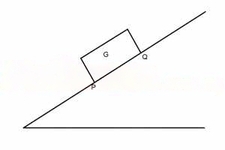
The solid will fall over if the vertical line through G lies outside the base
The solid will fall over if the vertical line through lies inside the base
The solid will not fall over if the vertical line through G lies outside the base
The solid can never fall over
Correct answer is A
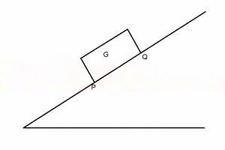
The solid will fall over if when the vertical line through G lies outside the base, when slightly tilted
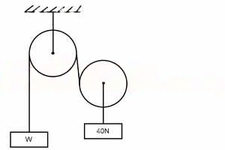
13.3N
20.0N
40.0N
80.0N
Correct answer is D
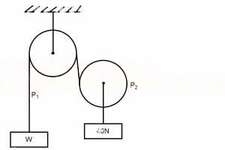
With P1 and P2 as shown (make a V.R of 2), the weight W = 40N * 2 = 80N
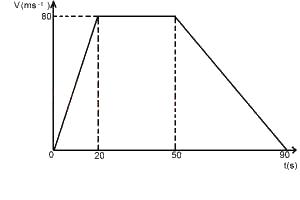
8.0 ms-2, 4,0 ms-2
4.0 ms-2, 8.0 ms-2
4.0 ms-2, 2.0 ms-2
2.0 ms-2, 4.0 ms-2
Correct answer is C
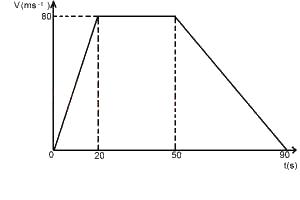
Acceleration = slope = AE/OE = 80/20 = 4m/s2
∴ acceleration and retardation = 4m/s2; 2m/s2
Vibration in a stretched spring cannot be polarized because they are
stationary waves
transverse waves
longitudinal waves
mechanical waves
Correct answer is C
In longitudinal waves, such as sound waves in a liquid or gas, the displacement of the particles in the oscillation is always in the direction of propagation, so these waves do not exhibit polarization.
the pressure of 3 moles of an ideal gas at a temperature of 27°C having a volume of 10-3m3 is
2.49 x 10⁵-2
7.47 x 10⁵-2
2.49 x 10⁶-2
7.47 x 10⁶-2
Correct answer is D
From the relation PV = nRT
V = 10-33; n = 3 moles; T = 27 + 273 = 300k
R = 8.3 j mol-1 K-1
=> P = nRT/V = 3 X 8.3 X 300/10-3 = 7.47 X 10⁶ Nm-2