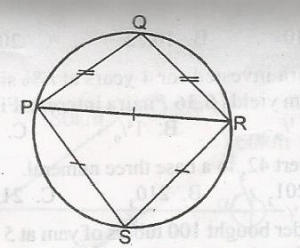
In the diagram, /PQ/ = /QR/ and /PR/ = /RS/ = /SP/, calculate the side of < QRS
150o
120o
90o
60o
Correct answer is C
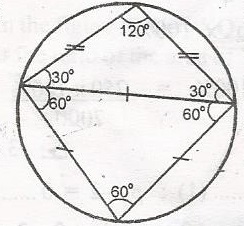
Since |PR| = |RS| = |SP|
\(\bigtriangleup\) PRS is equilateral and so < RPS = < PRS = < PSR = 70o
But < PQR + < PSR = 180o (Opposite interior angles of a cyclic quadrilateral)
< PQR + 60 = 180o
< PR = 180 - 60 = 120o
But in \(\bigtriangleup\) PQR, PQ = PR, hence < QPR = < PRQ(Base angles of an Isosceles triangle)
< QPR + < PRQ + < PQR = 180o (Angles in a triangle)
2 < QPR + 120 = 18-
2 < QPR = 180 - 120
QPR = \(\frac{60}{2}\) = 30o
From the diagram, < QRS = < PRQ + < PRS
30 + 60 = 90o
Similar Questions
\(\begin{pmatrix} -2 & 1 \\ 2 & 3 \end{pmatrix}\) \(\begin{pmatrix}p & q \\ r &...
Simplify \(\sqrt{27}\) + \(\frac{3}{\sqrt{3}}\)...
If (x - a) is a factor of bx - ax + x2 - ab, what is the other factor?...
Find the non-zero positive value of x which satisfies the equation \(\begin{bmatrix} x & ...
From the venn diagram above, the complement of the set P\(\cap\)Q is given by...
The identity element with respect to the multiplication shown in the diagram below is \(\begin{...