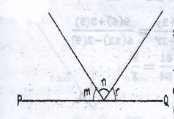
In the diagram, PQ is a straight line, (m + n) = 110\(^o\) and (n + r) = 130\(^o\) and (m + r) = 120\(^o\). Find the ratio of m : n : r
2 : 3 : 4
3 : 4 : 5
4 : 5 : 6
5 : 6 : 7
Correct answer is D
m + n = 110\(^o\), (n + r) = 130\(^o\)
(m + n) = 120\(^o\)
then, r = 130\(^o\) - n
and;
m + (130^o - n) = 120\(^o\)
m - n = -10\(^o\)
2m + (n + r) = 110 + 120 = 230
2m + 130 = 230
2m = 230 - 130
m = \(\frac{100}{2}\) = 50\(^o\)
n = 110\(^o\) - 50\(^o\)
= 60\(^o\)
r = 130\(^o\) - 60\(^o\) = 70\(^o\)
Hence, the ratio m : n : r
= 50 : 60 : 70
= 5 : 6 : 7
Similar Questions
A bricklayer charges ₦1,500 per day for himself and ₦500 per day for his assistant. If a two bed...
\(\frac{d}{dx} [\log (4x^3 - 2x)]\) is equal to...
The shaded portion shows the outer boundary of the half plane defined by the inequality ...
In the diagram above, PQ is parallel to TU, ∠PQR = 50°, ∠QRS = 86° and &an...
The volume of a cone of height 9cm is 1848cm\(^3\). Find its radius. [Take π = 22/7]...
The currency used in a country is called 'Matimalik'(M) and is of base seven. A lady in that...
If x\(^2\) + 4 = 0, then x ?...
In the diagram above, O is the center of the circle, |SQ| = |QR| and ∠PQR = 68°. Calculate &...