light energy
low humidity
oxygen
nitrate
Correct answer is A
Proper light in the aquarium serves as a form of energy for the photosynthetic plants and animals, hence it is very important.
The most important factor(s) that influence(s) the ecological niche of an organism is/are the
water, light, and predator-prey relationship
food and water availability
physical environment
competition for food and space
Correct answer is D
The competition in a territory is the factor that basically determines whether or not a specie will survive or not in that territory. Ecological niche is the total package of the habits of a specie. The competition for food and water is the most important influencer of the ecological niche.
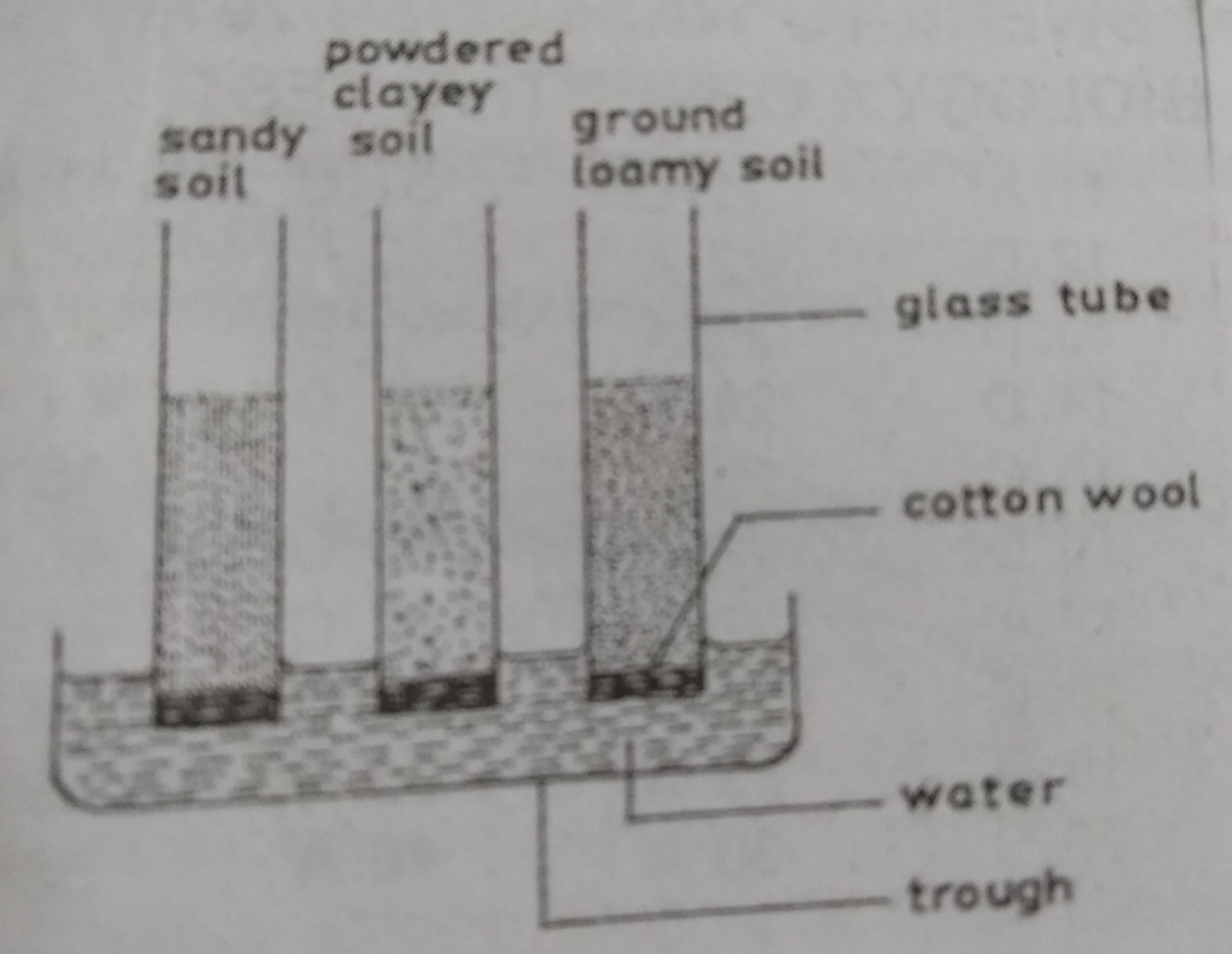
highest in sandy soil
lowest in loamy soil
to the same level in all soil types
highest in clayey soil
Correct answer is D
Capillarity in soil refers to the ability of a soil to allow and retain water. Clayey soil has the highest tendency to hold water hence, the water would rise highest in it.
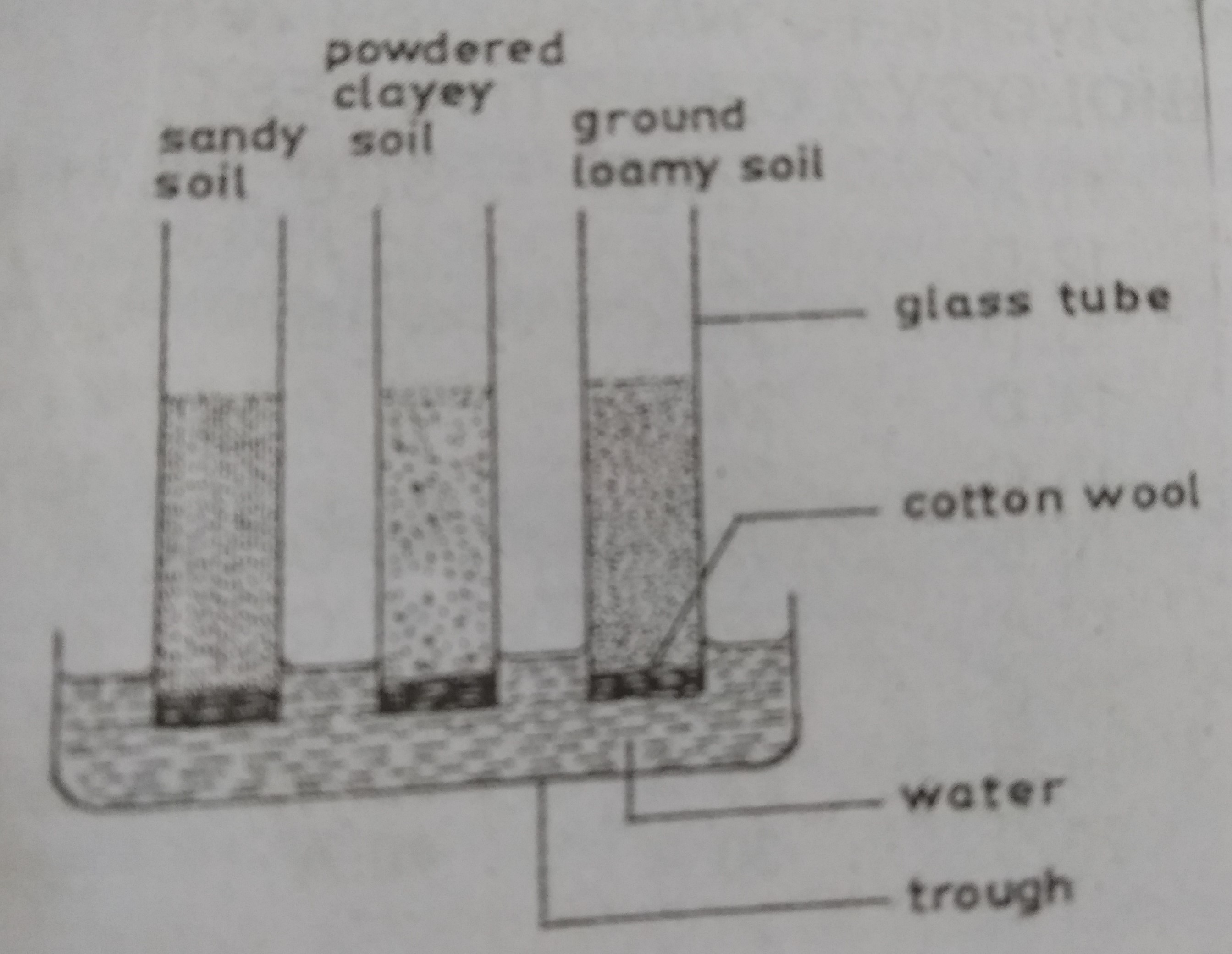
particle size
capillarity
colour
texture
Correct answer is B
The setup is to show the capillarity (water rise) of each of the soil types.
Which of the following dental formulae represents the dentition in rabbits?
\(I\frac{2}{1}\) \(C\frac{0}{0}\) \(P\frac{3}{2}\) \(M\frac{3}{3}\)
\(I\frac{2}{2}\) \(C\frac{1}{1}\) \(P\frac{2}{2}\) \(M\frac{3}{3}\)
\(I\frac{1}{2}\) \(C\frac{0}{0}\) \(P\frac{2}{3}\) \(M\frac{3}{3}\)
\(I\frac{2}{1}\) \(C\frac{0}{1}\) \(P\frac{3}{2}\) \(M\frac{3}{3}\)
Correct answer is A
The normal dental formula of rabbits is I2/1 C0/0 P3/2 M3/3 for 28 teeth.
WAEC Subjects
Aptitude Tests