2400J
6800J
7251J
24000J
Correct answer is D
The quantity of heat needed to melt ice = mL (where m is the mass of ice and L is the specific latent heat of fusion of ice)
Q = \(50 \times 336 = 16800J\) but this is 70% of the total heat supplied so that we have,
70% total heat = 16800J
\(\frac{70}{100}\) of total heat = 16800J
⇒ Total heat supplied = \(\frac{16800\times100}{70} = 24000J\)
The energy stored in a spring of stiffness constant k = 2000\(Nm^{-1}\) when extended 4cm is
0.16J
1.60J
16.00J
160.00J
Correct answer is B
The spring constant = the measure of stiffness = 2000\(Nm^{-1}\)
Energy stored in a spring = Work done to stretch it through a distance = change in potential energy
= \(\frac{kx^{2}}{2}\) = \(\frac{2000 \times (0.04)^{2}}{2}\) (converting 4cm to metres)
= \(\frac{3.2}{2} = 1.60J\)
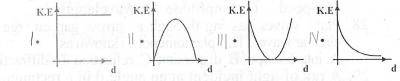
I
II
III
IV
Correct answer is B
No explanation has been provided for this answer.
A body can undergo the following types of motion except
random
rotational
translational
relative
Correct answer is D
Relative motion is the calculation of the motion of an object with regard to some other moving object. Hence, relative motion is not a type of motion.
The angle at which a projectile must be fired to cover maximum range is
30°
45°
60°
90°
Correct answer is B
The formula is \(\frac{v^{2}sin2\theta}{g}\)
And the sine graph is highest at 1 with its inverse as 90°. Hence, \(2\theta\) = 90°
\(\theta\) = 45°
WAEC Subjects
Aptitude Tests