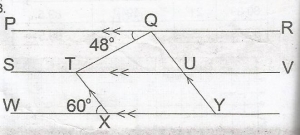
In the diagram, PR||SV||WY|, TX||QY|, < PQT = 48o and < TXW = 60o.Find < TQU.
120o
108o
72o
60o
Correct answer is C
In the diagram, < TUQ + 60o(corresp. angles)
< QTU = 48o (alternate angles)
< QU + 60o + 48o = 180o(sum of angles of a \(\Delta\))
< TQU = 180o - 108o
= 72o
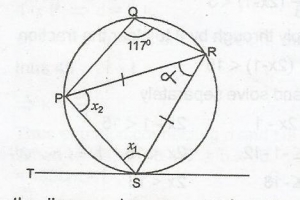
In the diagram, TS is a tangent to the circle at S. |PR| and < PQR = 177o. Calculate < PST.
54o
44o
34o
27o
Correct answer is A
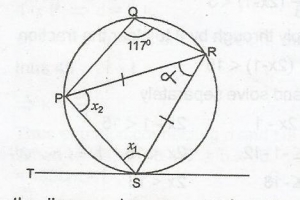
In the diagram above, x1 = 180o - 117o = 63o(opposite angles of a cyclic quad.)
x1 = x2 (base angles of isos. \(\Delta\))
x1 + x2 + \(\alpha\) = 180o (sum of angles of a \(\Delta\)
63o + 63o + \(\alpha\) = 180o
\(\alpha\) = 180o - (63 + 63)o
= 54o
4.5m
6.0m
7.5m
9.0m
Correct answer is C
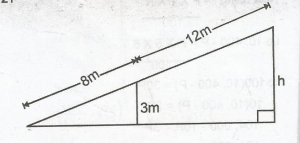
By similar triangles, \(\frac{8}{3}\) = \(\frac{8 + 12}{h}\)
\(\frac{8}{3} = \frac{20}{h}\)
h = \(\frac{3 \times 20}{8}\)
= 7.5m
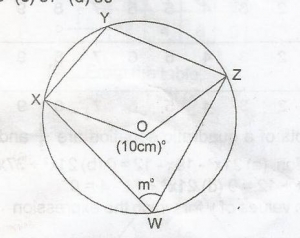
30
36
40
72
Correct answer is A
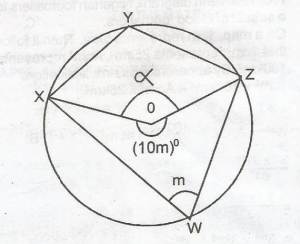
In the diagram above, \(\alpha\) = 2mo (angle at centre = 2 x angle at circumference)
\(\alpha\) + 10mo = 360o (angle at circumference)
\(\alpha\) + 10mo = 360o(angles round a point)
2mo + 10mo = 360o
12mo = 360o
mo = \(\frac{360^o}{12}\)
= 30o
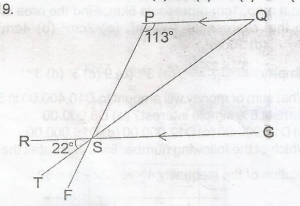
22o
45o
67o
89o
Correct answer is B
In In the diagram given, \(\alpha\) = 22o (vertically opp. angles), \(\alpha\) = \(\beta\) (alternate angles)
< PSQ + 133o + \(\beta\) = 180o (sum of angles of a \(\Delta\))
< PSQ + 133o + 22o = 180o
< PSQ = 180o - (133 + 22)o
45o
WAEC Subjects
Aptitude Tests