Mathematics questions and answers

Mathematics Questions and Answers

How good are you with figures and formulas? Find out with these Mathematics past questions and answers. This Test is useful for both job aptitude test candidates and students preparing for JAMB, WAEC, NECO or Post UTME.
581.

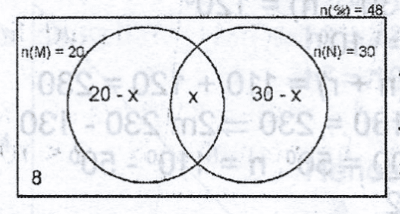
M and N are two subsets of the universal set (U). If n(U) = 48, n(M) = 20, n(N) = 30 and n(MUN) = 40, find n(M \(\cap\) N)

A.

18

B.

20

C.

30

D.

38

Correct answer is D

Let n(M \(\cup\) N \) = x

Then 20 - x + x + 30

- x = n(M \(\cup\) N)

50 - x = 40

50 - 40 = x

10 = x

x = 10

Hence, n(M \(\cup\N)' = 8  + (20 - 10) + (30 + 10)

= 8 + 10 + 20

= 38

582.

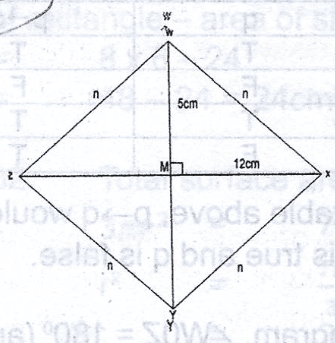
The diagonals of a rhombus WXYZ intersect at M. If |MW| = 5cm and |MX| = 12cm, calculate its perimeter

A.

42cm

B.

48cm

C.

52cm

D.

60cm

Correct answer is C

Let the length of a side of the rhombus be n

Then, n\(^2\) = 5\(^2\) + 12\(^2\)

= 25 + 144 = 169

n = \(\sqrt{169}\)

= 13cm

Hence, perimeter of rhombus = 4n = 4 x 13

= 52cm

583.

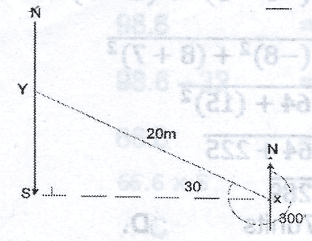
Given that Y is 20cm on a bearing of 300\(^o\) from x, how far south of y is x?

A.

10cm

B.

15cm

C.

25cm

D.

30cm

Correct answer is A

In \(\bigtriangleup\)YSC, sin 30\(^o\) = \(\frac{YS}{20}\)

|YS| = 20 sin 30\(^o\)

= 20 x 0.5

10m


584.

If tan x = \(\frac{4}{3}\), 0\(^o\) < x < 90\(^o\), find the value of sin x - cos x

A.

\(\frac{1}{10}\)

B.

\(\frac{1}{5}\)

C.

\(\frac{5}{12}\)

D.

1\(\frac{2}{5}\)

Correct answer is B

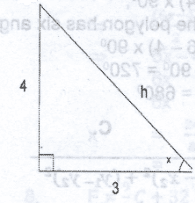
From the diagram,

h\(^2\) = 4\(^2\) + 3\(^2\) (pythagoras')

h\(^2\) = 16 + 9 = 25

h = \(\sqrt{25}\) = 5

Hence, sin x - cos x

= \(\frac{4}{5} - \frac{3}{5}\)

= \(\frac{1}{5}\)

585.

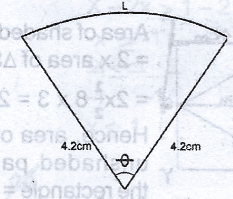
A piece of thread of length 21.4cm is used to form a sector of a circle of radius 4.2cm on a piece of cloth. Calculate, correct to the nearest degree, the angle of the sector. [Take \(\pi = \frac{22}{7}\)]

A.

170\(^o\)

B.

192\(^o\)

C.

177\(^o\)

D.

182\(^o\)

Correct answer is B

Length of arc, L = 21.4 - 2 x 4.2cm

= 21.4 - 8.4

= 13cm

But L = \(\frac{\theta}{360^o}\) x 2\(\pi r\)

i.e 13 = \(\frac{\theta}{360^o}\)  x 2 x \(\frac{22}{7}\) x 4.2

= 13 x 360\(^o\) x 7

= \(\theta\) x 2 x 22 x 4.2

\(\theta\) = \(\frac{13 \times 360^o \times 7}{44 \times 4.2}\)

= \(\approx\) 177.27\(^o\)

\(\approx\) 177\(^o\) (to the nearest degree)