Mathematics questions and answers

Mathematics Questions and Answers

How good are you with figures and formulas? Find out with these Mathematics past questions and answers. This Test is useful for both job aptitude test candidates and students preparing for JAMB, WAEC, NECO or Post UTME.
1,661.

Three angles of a nonagon are equal and the sum of six other angles is 1110o. Calculate the size of one of the equal angles.

A.

210o

B.

150o

C.

105o

D.

50o

Correct answer is D

Sum of interior angles of any polygon is (2n - 4) right angle; n angles of the nonagon = 9

where 3 are equal and 6 other angles = 1110o

( 2 x 9 - 4)90o = (18 - 4)90o

= 14 x 90o = 1260o

9 angles = 12600, 6 angles = 1110o

Remaining 3 angles = 1260o - 1110o = 150o

size of one of the3 angles \(\frac{150}{3}\) = 50o

1,662.

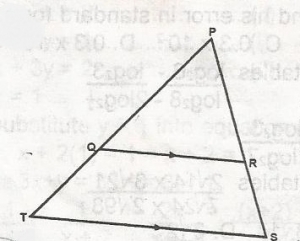
In the diagram above, QR // TS, QR : TS = 2.3, Find the ratio of the area of triangle PQR to the area of the trapezium QRST.

A.

4:9

B.

4:5

C.

1:3

D.

2:3

Correct answer is B

h1 = \(\frac{h_1 + h_2}{1.5}\) = \(\frac{h_1}{h_2} = 2\)

\(\frac{A_{\bigtriangleup PQR}}{A_{TP(QRST)}} = \frac{\frac{1}{2} \times 2 \times h_1}{\frac{1}{2} \times h_2 (2 + 3)}\)

\(\frac{2}{5} \times \frac{h_1}{h_2} = \frac{2}{5} \times 2\)

= \(\frac{4}{5}\)

1,663.

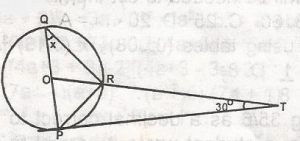
In the diagram, POQ is a diameter, 0 is the centre of the circle and TP is a tangent. Find the value of x

A.

30o

B.

40o

C.

45o

D.

50o

Correct answer is A

From the diagram, POQ is a diameter; o is the centre of the circle and TP is a tangent where RTP = 30o

RTP = RQP = x(at circumference = made by tangent outside the circle) i.e x = 30o

1,664.

An (\(n - 2)^2\) sided figure has n diagonals. Find the number n diagonals for a 25-sided figure

A.

7

B.

8

C.

9

D.

10

Correct answer is A

(n-2)\(^2\)=25

n - 2 = 5

n = 5 + 2 = 7

1,665.

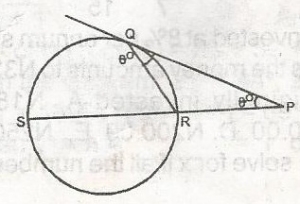
In the figure, PQ is the tangent from P to the circle QRS with SR as its diameter. If QRS = \(\theta\)oand RQP = \(\phi\)o, which of the following relationships between \(\theta\)o and \(\phi\)o is correct

A.

\(\theta\)o + \(\phi\)o = 902

B.

\(\phi\)o = 902 - 2\(\theta\)o

C.

\(\theta\)o = \(\phi\)o

D.

\(\phi\)o = 2\(\theta\)o

E.

\(\theta\)o + 2\(\phi\)o

Correct answer is E

180 - \(\phi\)o = \(\theta\)o + \(\phi\)o (Sum of opposite interior angle equal to its exterior angle)

180 = 2\(\phi\) + \(\theta\)o