
Physics Questions and Answers
If you want to learn more about the nature and properties of matter and energy or you're simply preparing for a Physics exam, these Physics past questions and answers are ideal for you.
If you want to learn more about the nature and properties of matter and energy or you're simply preparing for a Physics exam, these Physics past questions and answers are ideal for you.
3.54nC
42.5nC
35.4nC
4.25nC
Correct answer is B
A= \(0.8m^2\) d= 20mm =\(\frac{20}{1000}\) = 0.02m
v =120v; \(ε_oA\)= \(8.85 × 10^-12 fm^-1\)
C = \(\frac{ε_oA}{d}\)
C =\(\frac{8.85 × 10^-12×0.8}{0.02}\)
C= \(3.54 × 10^-10 F\)
Q= CV
⇒ \(3.54 × 10^-10\) × 120 = \(4.25×10^-8c\)
Q=\(42.5 × 10^-9c\) = 42.5nC
6.43 cm
8.24 cm
4.26 cm
5.82 cm
Correct answer is D
\(r_1\) = 4.5cm , \( P_1\) =is the total pressure on the bubble at a depth of 12m from the surface.
\(P_1\) = 12 + 10.34 =22.34m
\(V_1\) = \(\frac{4}{3}\)π× \(r^3_1\)
= \(\frac{4}{3}× π×{4.5^3cm^3}\)
\(P_2\) = 10.34m
\(V_2\) = \(\frac{4}{3} {π}{r^3_2}\)
from boyles law:
\(P_1V_1\) = \(P_2V_2\)
⇒ 22.34× \(\frac{4}{3}× π×{4.5^3}\) = 10.34 × \(\frac{4}{3}×π×{r^3_2}\)
⇒ 22.34 × \(4.5^3\) = 10.34 × \(r^3_2\)
⇒ \(r^3_2 = \sqrt[3]{196.88}\)
⇒ \(r_2\) = 5.82cm
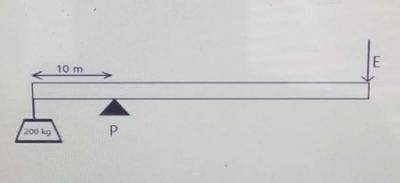
250
300
450
200
Correct answer is A
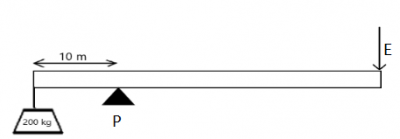
ε= 80%, L=200× 10 = 2000N, \(d_L\)=10m
\(d_E\)= 110-10 = 100m, E=?
ε = \(\frac{work done on the load}{work done by the effort}\) × 100%
⇒ work done on load = 2000 ×10 =20,000 j
⇒ work done by effort = E × 100 = 100E
⇒ 80 = \(\frac{20,000}{100E}\) × 100%
⇒ 80 = \(\frac{20,000}{E}\)
⇒ E = \(\frac{20,000}{80}\)
⇒ E = 250N
400
288
240
379
Correct answer is D
m=2kg, r=1.2m, f=120rev/min ; T=?
f= \(\frac{120rev}{1min}\) × \(\frac{1min}{60s}\) = 2rev\s
w=2πf= 2×π×2= 4πrad\s
T= \(\frac{mv^2}{r}\), but v = wr
⇒ T = \(\frac{(m)(wr)^2}{r}\)
⇒ T = \(mw^2r\)
= T = 2× (4π)^2 × 1.2
T = 379N ( to 3 s.f)
\(2.4×10^{10}(Nm^{-2})\)
\(1.5×10^{10}(Nm^{-2})\)
\(2.4×10^9(Nm^{-2})\)
\(1.3×10^{10}(Nm^{-2})\)
Correct answer is A
r=0.2mm = \(2 × {10^{-4}}\) e= 0.05% of L,=0.005L, m=1.5kgg=\(10 ms^{-2}\) , y=?,
(1000 mm = 1m)
Y = \(\frac{FL}{Ae}\)
w = mg = 1.5 × 10 = 15
A = \(\pi r^2\) = \(\frac{22}{7}×(2×10^{-4})^2\) = \(1.26×10^{-7}(m^2)\)
⇒ Y = \(\frac{15L}{1.26×10^{-7}×0.005L}\)
⇒ Y = \(\frac{15}{1.26×10^{-7}×0.005}\)
⇒ Y = \(\frac{15}{6.29×10^{-10}}\)
Y = \(2.4×10^{10}(Nm^{-2})\)