
Economics Questions and Answers
Economics questions and answers to help you prepare for JAMB, WAEC, NECO, Post UTME and job aptitude tests or interviews.
Economics questions and answers to help you prepare for JAMB, WAEC, NECO, Post UTME and job aptitude tests or interviews.
Perfect competition
Monopoly
Demand curve
Competitive market
Correct answer is B
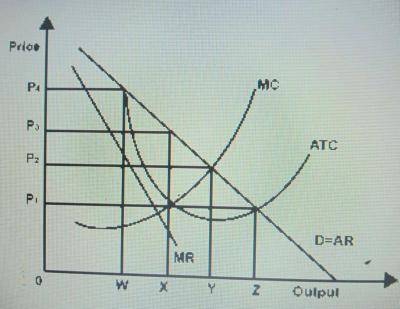
The diagram above represent a monopolist diagram.
The fundamental problem of economics is
Finding striking determinants between the forces of supply and demand
The scarcity of productive resources relative to society's unlimited wants
The establishment of a political framework to determine the what, how and for whom of production
To establish an equitable distribution of income
Correct answer is B
The fundamental problem of Economics is Scarcity. Scarcity explains the basic economic problem that the world has limited or scarce resources to meet seemingly unlimited wants, and this reality forces people to make decisions about how to allocate resources in the most efficient way.
.............is presently used in Nigeria to measure inflation
GNP implicit price deflator
Consumer price index
Wholesale price index
Real Gross Domestic Product
Correct answer is B
In Nigeria, the Consumer Price Index (CPI) is used to measure inflation. The CPI measures the average change over time in the prices paid by urban consumers for a market basket of consumer goods and services. It is the most widely used measure of inflation and is sometimes viewed as an indicator of the effectiveness of government economic policy.
A major factor contributing to productivity is
Immigration of young workers
The labour force
The baby boom of generation
The rate of GDP per year
Correct answer is B
Labour is by far the most common of the factors used in measuring productivity. One reason for this is, of course, the relatively large share of labour costs in the value of most products.
The development of an economic hypothesis through intuition, insight, or logic is associated with
Deduction
Policy economics
Normative economics
Induction
Correct answer is C
Normative economics is a perspective on economics that reflects normative, or ideologically prescriptive judgments toward economic development, investment projects, statements, and scenarios. It expresses ideological judgments about what may results in economic activity if public policy changes are made.