high velocity electrons are abruptly stopped in metals
energy changes occur within the nuclei of atoms
energy changes occur within the electronic structure of atoms
electrons are deflected in very strong magnetic fields
Correct answer is B
Gamma rays are produced in the disintegration of radioactive atomic nuclei and in the decay of certain subatomic particles.
Gamma radiation is emitted by excited nuclei or other processes involving subatomic particles;
it often accompanies alpha or beta radiation, as a nucleus emitting those particles may be left in an excited (higher-energy) state.
\(\frac{11}{18}\)
\(\frac{11}{20}\)
\(\frac{7}{22}\)
\(\frac{5}{19}\)
Correct answer is B
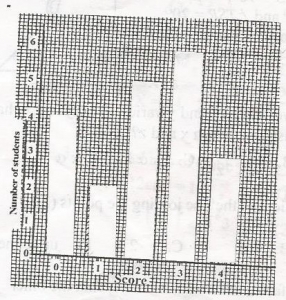
at most 2 marks = 5 + 2 + 4 students = 11 students
probability(at most 2 marks) = \(\frac{11}{20}\)
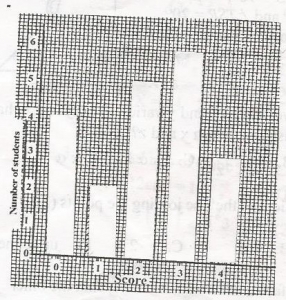
The bar chart shows the scores of some students in a test. How many students took the test?
18
19
20
22
Correct answer is C
score 0 = 4 students
score 1 = 2 students
score 2 = 5 students
score 3 = 6 students
score 4 = 3 students
= 20 students
1.22 x 10\(^{-10}\)m
4.10 x 10\(^{-10}\)m
3.90 x 10\(^{-10}\)m
5.50 x 10\(^{-14}\)m
Correct answer is D
de broglie wavelength formula in terms of kinetic energy:
λ = \(\frac{h}{\sqrt{2mE}}\)
λ = \(\frac{6.6 *10^{-34}}{\sqrt{2 *9.1*10^{-31} *100 }}\)
λ = 5.50 x 10\(^{-14}\)m
I < III < II
II < I < III
II < III < I
I < II
Correct answer is C
Alpha particles are highly ionising because of their double positive charge, large mass (compared to a beta particle) and because they are relatively slow.
They can cause multiple ionisations within a very small distance.
And the gamma radiation has the least ionising power.
WAEC Subjects
Aptitude Tests