The refracted angle is less than the incident angle if the speed is higher in the first material
Its wavelength does not change
It bends away from the normal if the speed is lower in the first material
Its frequency changes.
Correct answer is D
Refraction occurs when light travels from one medium to another which changes the speed at which the light travels.
This causes light to bend upon incidence with the interface of a new material.
Angle of refraction is smaller than angle of incidence when light ray travels from rarer medium to denser medium.
I.e light can either refract towards the normal(when slowing down while crossing the boundary) or away from the normal (when speeding up while crossing the boundary).
When light undergoes refraction, its frequency remains the same.
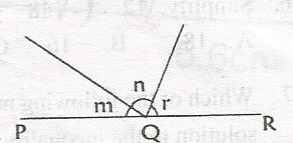
In the diagram, PQR is a straight line, (m + n) = 120o and (n + r) = 100o. Find (m + r)
110o
120o
140o
160o
Correct answer is C
No explanation has been provided for this answer.
Conduction
Diffusion
Convection
Radiation
Correct answer is D
Radiation is energy that comes from a source and travels through space and may be able to penetrate various materials.
Light, radio, and microwaves are good examples
152.6 °C
182.6 °C
306.1 °C
335.5 °C
Correct answer is A
L1=50.
T1 = 30 + 273 = 303k
Linear expansivity = 1.9 x 10\(^{-5}\)
L2 = 50.29
Temp rise= ?
L2 - L1 = 50.29 - 50 = 0.29
Linear expansivity = \(\frac{L2-L1}{L1(T2-T1)}\)
1.9 x 10\(^{-5}\) = \(\frac{0.29}{50*(T2 - 303)}\)
1.9 x 10\(^{-5}\) * 50 (T2 - 303) = 0.29
T2 = \(\frac{0.29}{50 * 1.9 * 10^{-5}}\) + 303
T2 = 152.6 °C
Which of the following statements-about electromagnetic waves is not correct?
They carry energy as they travel through space
They travel with the speed of light
They are longitudinal
The electric and magnetic fields are at right angles to each other
Correct answer is C
All electromagnetic waves are:
- transverse waves; can travel through a vacuum ;
- travel at exactly the same speed in a vacuum, the speed of light, 300,000,000 m/s.
- transfer energy from one place to another;
- can be reflected;
- can be refracted .
- The oscillations of and are perpendicular to each other and are in the same phase.
WAEC Subjects
Aptitude Tests