1.5 ms\(^{-1}\)
6.0 m s\(^{-1}\)
17.3 m s\(^{-1}\)
24.5 m s\(^{-1}\)
Correct answer is D
v = ?, u = 0, a = 10, s = 30
V² = U²+2as
V² = 0 + 2 * 10 * 30
V² = 0 + 600
V = √600
V = 24.5m/s
20
25
45
65
Correct answer is B
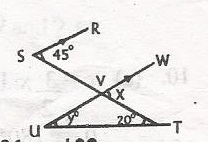
xo + zo = 180o (sum of < on str. line)
45o + zo = 180o
zo = 180o - 45o
z = 135o
z + yo + 20o = 180o (sum of < s in \(\bigtriangleup\))
135o + yo + 20o = 180o
yo + 155o = 180o
yo + 180o - 155o
yo = 25o
rise steadily
fall steadily
fall and then rises
rise and then falls
Correct answer is D
When water is heated, the density rises and falls steadily, remember the anomalous expansion of water.
20
45
65
135
Correct answer is B
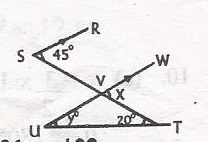
From the diagram SR//UW given that < RSV = 45o and < WVT = xo
< WVT = 45o(corresponding angle)
xo = 45
44.0 m
22.2 m
11.1 m
5.5 m
Correct answer is B
Acceleration[a] = \(\frac{[forward - resistive]force}{mass}\)
a = \(\frac{1240-800}{1220}\) → \(\frac{440-800}{1220}\)
a = 0.36m/s\(^2\), v = 4m/s, s = ?
Second equation of motion:
s is distance
u is initial velocity
v is final velocity
a is acceleration
v\(^2\) = u\(^2\) + 2as
4\(^2\) = 0\(^2\) + 2 * 0.36 * s
16 = 0.72s
22.2m = s
WAEC Subjects
Aptitude Tests