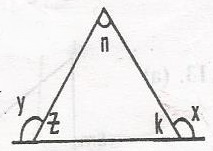
In the diagram, the value of x + y = 220o. Find the value of n
20o
40o
60o
80o
Correct answer is B
y + z = 180o
z = 180o - y
x + k = 180o
k = 180o - x
the sum of angles in the \(\bigtriangleup\) are: n + z + k = 180
but n + 180o - y + 180o - x = 180o
n + 180o - y - x = 0
but we want to find n
n + 180o = x + y
but x + y = 220o
n + 180o = 220o
n = 220o - 180o
n = 40o
28.6ºC
30.0 ºC
35.0 ºC
40.5 ºC
Correct answer is C
\(\frac{10.5-0}{30-0}\) = \(\frac{c-0}{100-0}\)
\(\frac{10.5}{30}\) = \(\frac{c}{100}\)
cross multiply:
10.5 * 100 = 30c
35.0 ºC = c
340 ms\(^{-1}\)
380 m s\(^{-1}\)
400 m s \(^{-1}\)
680 m s\(^{-1}\)
Correct answer is A
speed of the sound wave = \(\frac{distance * 2}{time}\)
= \(\frac{408 * 2}{2.4}\)
: speed of the sound wave = 340 ms\(^{-1}\)
longitudinal
transverse
mechanical
a sound wave
Correct answer is B
In physics, a transverse wave is a wave whose oscillations are perpendicular to the direction of the wave's advance.
This is in contrast to a longitudinal wave which travels in the direction of its oscillations. Water waves are an example of transverse wave.
15 hours
30 hours
45 hours
60 hours
Correct answer is C
No explanation has been provided for this answer.
WAEC Subjects
Aptitude Tests