How good are you with figures and formulas? Find out with these Mathematics past questions and answers. This Test is useful for both job aptitude test candidates and students preparing for JAMB, WAEC, NECO or Post UTME.
7 significant figures
3 significant figures
4 significant figures
5 significant figures
Correct answer is D
The two trailing zeros in the number are not significant, but the other five are, making it a five-figure number.
16 cm
8 cm
5 cm
10 cm
Correct answer is D
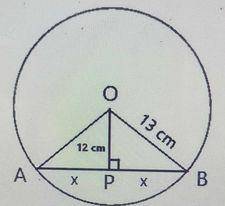
|AP| = |PB| = \(x\) (The perpendicular to a chord bisects the chord if drawn from the center of the circle.)
From ∆OPB
Using Pythagoras theorem
⇒ \(13^2 = 12^2 + x^2\)
⇒ \(169 = 144 + x^2\)
⇒ \(169 - 144 = x^2\)
⇒ \(x^2 = 25\)
⇒ \(x = \sqrt25 = 5 cm\)
∴ Length of the chord |AB| = \(x + x = 5 + 5 = 10 cm\)
θ = 223\(^o\), 305\(^o\)
θ = 210\(^o\), 330\(^o\)
θ = 185\(^o\), 345\(^o\)
θ = 218\(^o\), 323\(^o\)
Correct answer is D
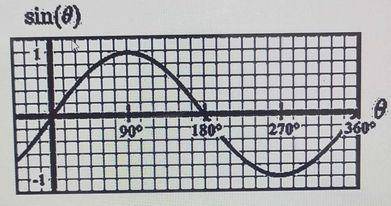
On the \(y\)-axis, each box is \(\frac{1 - 0}{5} = \frac{1}{5}\) = 0.2unit
On the \(x\)-axis, each box is \(\frac{90 - 0}{6} = \frac{90}{6} = 15^o\)
⇒ \(θ_1 = 180^o + (2.5\times15^o) = 180^o + 37.5^o = 217.5^o ≃ 218^o \)(2 and half boxes were counted to the right of 180\(^o\))
⇒ \(θ_2 = 270^o + (3.5\times15^o) = 270^o + 52.5^o = 322.5^o ≃ 323^o \)(3 and half boxes were counted to the right of 270\(^o\))
∴ \(θ = 218^o, 323^o\)
62 km
97 km
389 km
931 km
Correct answer is A
AB = \(\frac{θ}{360}\times 2\pi Rcos\propto\) (distance on small circle)
= 64 - 56 = 8\(^o\)
\(\propto = 86^o\)
⇒ AB = \(\frac{8}{360}\) x 2 x 3.142 x 6370 x cos 86
⇒ AB = \(\frac{22,338.29974}{360}\)
∴ AB = 62km (to the nearest km)
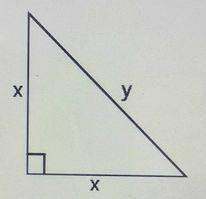
The perimeter of an isosceles right-angled triangle is 2 meters. Find the length of its longer side.
2 - \(\sqrt2\)
-4 + 3\(\sqrt2\)
It cannot be determined
-2 + 2\(\sqrt2\) m
Correct answer is D
Perimeter of a triangle = sum of all sides
⇒ \(P = y + x + x = 2\)
⇒ \(y + 2x = 2\)
⇒ \(y= 2 - 2x\)-----(i)
Using Pythagoras theorem
\(y^2 = x^2 + x^2\)
⇒ \(y^2 = 2x^2\)
⇒ \(y = \sqrt2x^2\)
⇒ \(y = x\sqrt2\)-----(ii)
Equate \(y\)
⇒ \(2 - 2x = x\sqrt2\)
Square both sides
⇒ \((2 -2x) ^2 = (x\sqrt2)^2\)
⇒ \(4 - 8x + 4x^2 = 2x^2\)
⇒ \(4 - 8x + 4x^2 - 2x^2 = 0\)
⇒ \(2x^2 - 8x + 4 = 0\)
⇒ \(x = \frac{-(-8)\pm\sqrt(-8)^2 - 4\times2\times4}{2\times2}\)
⇒ \(x = \frac{8\pm\sqrt32}{4}\)
⇒ \(x = \frac{8\pm4\sqrt2}{4}\)
⇒ \(x = 2\pm\sqrt2\)
⇒ \(x = 2 + \sqrt2\) or \(2 - \sqrt2\)
∴ \(x = 2 - \sqrt2\) (for \(x\) has to be less than its perimeter)
∴ \(y = 2 - 2x = 2 - 2(2 - \sqrt2) = -2 + 2 \sqrt2\)
∴ The length of the longer side = -2 + 2\(\sqrt2\)m