How good are you with figures and formulas? Find out with these Mathematics past questions and answers. This Test is useful for both job aptitude test candidates and students preparing for JAMB, WAEC, NECO or Post UTME.
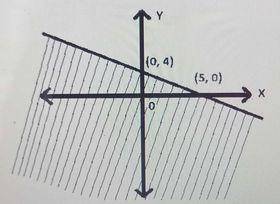
Which inequality describes the graph above?
\(4y + 5x ≥ 20\)
\(5y + 4x ≤ 20\)
\(4y + 5x ≤ 20\)
\(5y + 4x ≥ 20\)
Correct answer is B
First, we find the equation of the boundary line using the two intercepts.The slope is
m = \(\frac{4 - 0}{0 - 5} = {4}{5}\)
The y-intercept is 4
The slope-intercept form of the equation is therefore
y = -\(\frac{4}{5} x + 4\)
\(\implies y + \frac{4}{5} x = 4\)
Multiply both sides by \(\frac{5}{4}\)
\(\implies\frac{5}{4}(y +\frac{4}{5} x) = 4\times\frac{5}{4}\)
\(\implies\frac{5}{4} y + x = 5\)
Multiply both sides by 4
⇒ \(5y + 4x = 20\)
The inequality is therefore either \(5y + 4x ≤ 20\) or \(5y + 4x ≥ 20.\)
Using the test point (0, 0) -The origin
⇒ 5(0) + 4(0) ≤ 20
⇒ 0 ≤ 20 (True)
∴ The inequality is \(5y + 4x ≤ 20\)

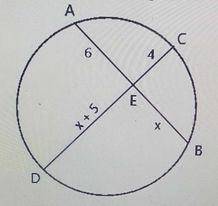
Find the value of x in the diagram above
10 units
15 units
5 units
20 units
Correct answer is A
Intersecting Chords Theorem states that If two chords intersect in a circle, then the products of the measures of the segments of the chords are equal.
⇒ AE * EB = CE * ED
⇒ 6 * \(x\) = 4 * (\(x\) + 5)
⇒ 6\(x\) = 4\(x\) + 20
⇒ 6\(x\) - 4\(x\) = 20
⇒ 2\(x\) = 20
∴ \(x = \frac{20}{2}\) = 10 units
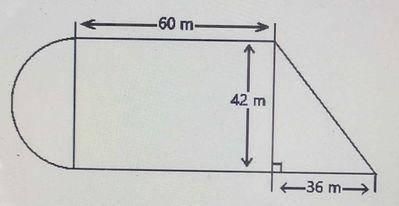
Calculate the area of the composite figure above.
6048 m\(^2\)
3969 m\(^2\)
4628 m\(^2\)
5834 m\(^2\)
Correct answer is B
Area of the composite figure = Area of semi circle + Area of rectangle + Area of triangle
Area of semi circle = \(\frac{1}{2}\pi r^2 = \frac{1}{2}\times\pi\times\frac{d^2}{4} = \frac{1}{2}\times\frac{22}{7}\times\frac{42^2}{4} = 693 m^2\)
Area of rectangle = l x b = 42 x 60 =2520 m\(^2\)
Area of triangle = \(\frac{1}{2}\times b \times h = \frac{1}{2}\times 36 \times 42 = 756 m^2\)
∴ Area of the composite figure = 693 + 2520 + 756 = 3969 m\(^2\)
Solve the logarithmic equation: \(log_2 (6 - x) = 3 - log_2 x\)
\(x\) = 4 or 2
\(x\) = -4 or -2
\(x\) = -4 or 2
\(x\) = 4 or -2
Correct answer is A
\(log_2 (6 - x) = 3 - log_2 x\)
⇒ \(log_2 (6 - x) = 3 log_2 2 - log_2 x\) (since \(log_2\) 2 = 1)
⇒ \(log_2 (6 - x) = log_2 2^3 - log_2 x\) \((a log\) c = \(log\) c\(^a)\)
⇒ \(log_2 (6 - x) = log_2 8 - log_2 x\)
⇒\(log_2 (6 - x) = log_2 \frac{8}{x}\) (\(log\) a - \(log\) b = \(log \frac{a}{b})\)
⇒ \(6 - x = \frac{8}{x}\)
⇒ \(x (6 - x) = 8\)
⇒ \(6x - x^2 = 8\)
⇒ \(x^2 - 6x + 8 = 0\)
⇒ \(x^2 - 4x - 2x + 8 = 0\)
⇒ \(x (x - 4) - 2(x - 4) = 0\)
⇒ \((x - 4)(x - 2) = 0\)
⇒ \(x - 4 = 0 or x - 2 = 0\)
∴ x = 4 or 2
20
300
50
60
Correct answer is D
Let number of children's ticket at ₦250.00 each = \(x\)
∴ Number of adult tickets at ₦520.00 each = 5\(x\)
Then,
Total amount of money received from children's tickets = 250\(x\)
Total amount of money received from adult tickets = 520(5\(x\))
⇒ 250\(x\) + 520(5\(x\)) = 171,000
⇒ 250\(x\) + 2600\(x\) = 171,000
⇒ 2850\(x\) = 171,000
⇒ \(x = \frac{171,000}{2850} = 60\)
∴ 60 tickets were sold at ₦250.00 and 300 tickets were sold at ₦520.00