
Mathematics questions and answers

Mathematics Questions and Answers

How good are you with figures and formulas? Find out with these Mathematics past questions and answers. This Test is useful for both job aptitude test candidates and students preparing for JAMB, WAEC, NECO or Post UTME.
2,871.

Simplify \(\left(\frac{3}{4} - \frac{1}{3}\right)\times 4\frac{1}{3}\div 3\frac{1}{4}\)

A.

\(\frac{5}{9}\)

B.

\(\frac{5}{16}\)

C.

\(\frac{8}{13}\)

D.

\(\frac{16}{5}\)

Correct answer is A

\((\frac{3}{4} - \frac{1}{3}) \times 4\frac{1}{3} \div 3\frac{1}{4}\)

= \((\frac{9 - 4}{12}) \times \frac{13}{3} \div \frac{13}{4}\)

= \(\frac{5}{12} \times \frac{13}{3} \times \frac{4}{13}\)

= \(\frac{5}{9}\)

2,872.

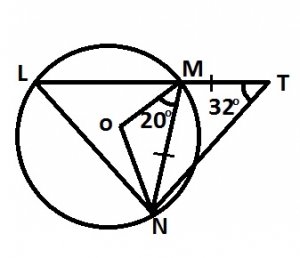
In the diagram, LMT is a straight line. lf O is the centre of circle LMN, OMN = 20°, LTN = 32° and |NM| = |MT|, find LNM.

A.

44o

B.

46o

C.

52o

D.

70o

Correct answer is B

< MNT = < MTN = 32°

< NMT = 180° - 2(32°) = 116°

< OMN + < NMT + < LMO = 180°

20° + 116° + < LMO = 180° \(\implies\) < LMO = 180° - 136° = 44°

< LMN = < LMO + < OMN

= 44° + 20° = 64°

< NOM = 180° - 2(20°) = 140°

< NLM = \(\frac{1}{2} \times < NOM = 70°\)

< LNM + < LMN + < NLM = 180°

< LNM + 64° + 70° = 180°

< LNM = 180° - 134° = 46°

2,873.

Which of the following is not a rational number?

A.

-5

B.

\(\sqrt{4}\)

C.

\(3\frac{3}{4}\)

D.

\(\sqrt{90}\)

Correct answer is D

No explanation has been provided for this answer.

2,874.

The number of goals scored by a school team in 10 netball matches are as follows: 3, 5, 7, 7, 8, 8, 8, 11, 11, 12. Find the probability that in a match, the school team will score at most 8 goals.

A.

\(\frac{7}{10}\)

B.

\(\frac{2}{5}\)

C.

\(\frac{3}{5}\)

D.

\(\frac{1}{5}\)

Correct answer is A

Number of at most 8 goals = 7

P(at most 8 goals) = \(\frac{7}{10}\)

2,875.

Given that \(p = x-\frac{1}{x} and\hspace{1mm}q = x^2 + \frac{1}{x^2}\) express q in terms of p.

A.

(p2 + 2)

B.

(p - 2) 2

C.

(p + 2) 2

D.

(p2 - 2)

Correct answer is A

Given \(p = x - \frac{1}{x}\); \(q = x^2 + \frac{1}{x^2}\).

\(p^2 = (x - \frac{1}{x})(x - \frac{1}{x})\)

\(p^2 = x^2 + \frac{1}{x^2} - 2\)

\(p^2 = q - 2 \implies q = p^2 + 2\)